
Before fear becomes your next move, there is an Edge.
A voice changes. Breath shortens. Heat rises. The body begins answering before thought can catch up. Edge to Path follows that interval: old protection is moving, and awareness has not yet been overtaken.
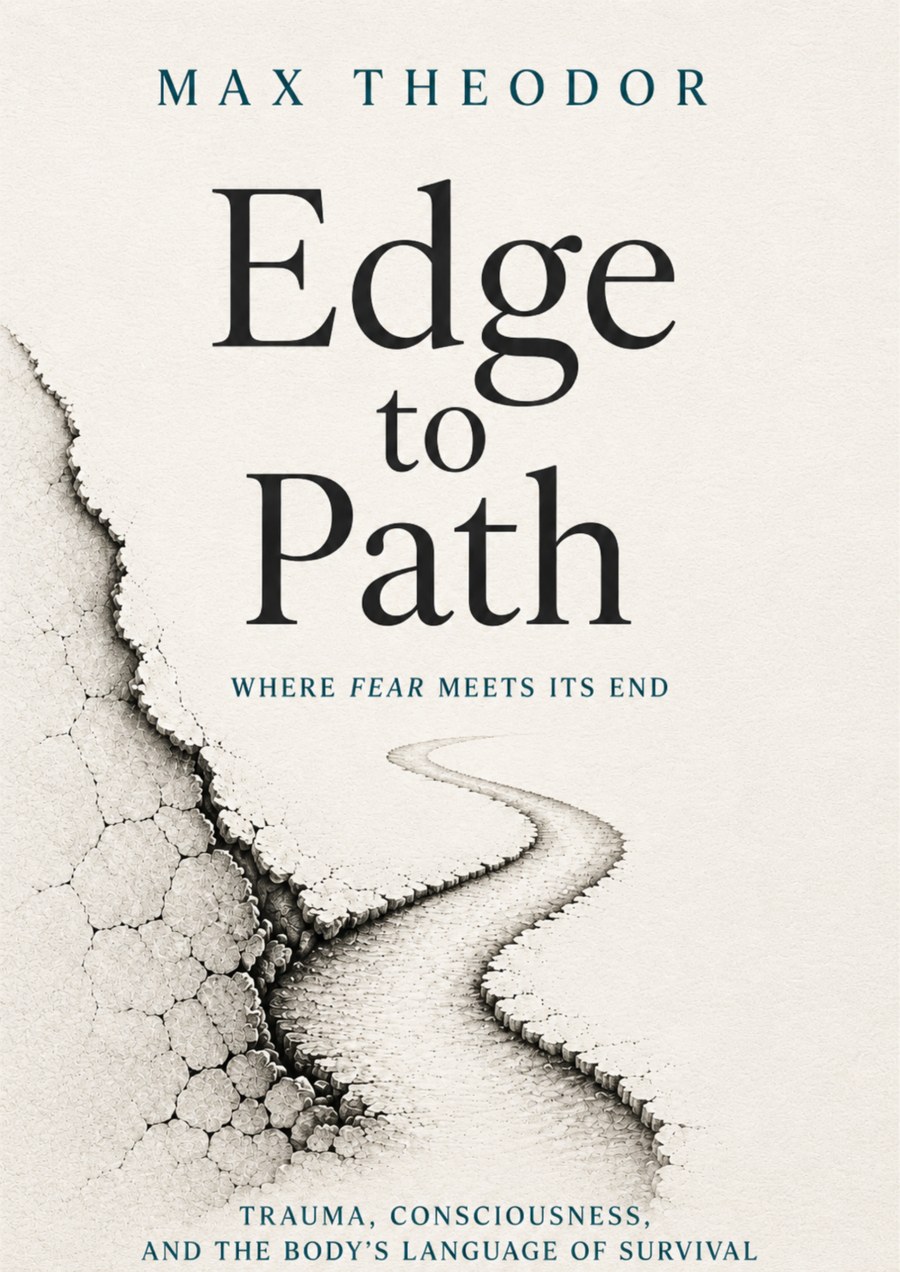
Buy Edge to Path
Secure checkout. Instant ebook delivery and reader support through BookFunnel.
It opens in a jail cell.
It does not stay that dark.
It comes closer to your own kitchen than you would expect.
By then, the danger may no longer be visible from the outside. It shows as a voice held too level, a hand closing, a sentence swallowed, a body bracing before anyone else knows why.
What began as protection can keep working long after the danger has passed. Edge to Path begins where that response hardens into identity, and the person carrying it can no longer feel where it began.
What the Book Follows
Edge to Path begins with the body’s first report: breath shortening, pressure gathering, a sentence formed inside and unable to reach the mouth.
From there, the book follows one human crossing through three altitudes.
Tom Campbell’s MBT asks what consciousness receives when fear narrows the choices still within reach.
Trauma neuroscience traces how the organism begins preparing for danger before the cue has been fully placed in context.
Somatic therapy stays with sensation, movement, pacing, completion, and return.
The frameworks remain distinct while illuminating the same human event.
Who This Book Is For
For the person who can explain the reaction after it passes, yet still feels the body obey it when the next moment comes.
You may know the history. You may have done therapy, meditation, study, spiritual work, or years of private effort. Still, under pressure, an old response reaches the body first.
Edge to Path is written for readers carrying shame, dissociation, chronic activation, old fear, or relational loops that insight has mapped without fully changing.
It is also for clinicians, coaches, somatic practitioners, MBT readers, and serious lay readers who want a bridge between lived experience, consciousness, neuroscience, and the body’s route back to reachable choice.
From the Seal to Completion
Seven crossings carry the reader through the book: from the record the body kept when language failed, to the moment an interrupted protective response finally finds its end. Each part opens into the chapters inside.
The Important Note establishes medical, mental-health, legal, crisis, practice, privacy, and current-danger boundaries. How to Read This Book then explains how testimony, neuroscience, somatic therapy, MBT, and author synthesis remain distinct, and invites the reader to move at the scale the body can hold.
Reader note: Chapter 1 contains graphic descriptions of violence, blood, dissociation, surgery, open wound care, and traumatic memory surfacing during meditation.
The book begins before theory has a place: fluorescent light, concrete, blood, and a wound the body keeps after the mind has moved on.
These chapters follow the first record: terror sealed below language, a life moving around it, and the past returning without a date.
The first need for a framework begins there.
Between Chapter 2 and Chapter 3, the book pauses to give the reader the consciousness language needed before the three frameworks meet.
A cabin door closes. The body receives trap. Fear narrows the moment until a single choice remains within reach.
Tom Campbell’s MBT enters there: consciousness, avatar, belief, solution space, decision space, intent, and the difference between knowing another route and having that route available inside the body.
The interlude prepares the crossing that follows: collapse viewed through MBT, neuroscience, and somatic therapy.
The same collapse is seen from three directions: consciousness, brain, and body.
Chapter 3 lets the frameworks stand close without forcing them into one language. Chapter 4 opens the view wider, into people who call their bracing sensitivity, their scanning intelligence, their withdrawal independence, or their control discipline.
This part begins the turn from one man’s testimony into the lives around him. The wound changes shape. The body’s report remains.
Sarah’s voice stops in a house where nothing visible has happened. David’s hands begin to shake over numbers that should have stayed numbers. A truth reaches the body and loses its path to speech.
These chapters follow the turn the book has been moving toward: sensation becoming instruction, protection hardening into silence or control, a report sealed before it reaches the mouth.
Then the book names the threshold.
The Edge is the narrow interval where an old response begins to take shape, while awareness still has enough ground to meet it before signal becomes command.
Torres sees war across his daughter’s face and has to find the child in front of him. The book enters the place where fear can fill the field and Observer access can fall beyond reach.
These chapters trace the gap people are often told to use, then show why it opens in one moment and closes in another. Its reach depends on body state, fear, belief, and available resource.
From there, the book turns toward belief and direction: the laws fear writes into a life, the work of meeting fear-written laws while they are active, and the possibility left after the wound refuses every easy meaning.
Intent places no one above anyone else. Conduct, cost, safety, and accountability remain questions in the shared world.
Related essay: Between stimulus and response: what the famous quote leaves outAfter the book has named the threshold in trauma, it brings the same crossing into daily life: a supervisor’s message, a child’s voice in the hallway, the drive home with the day still living in the skin.
These chapters widen the Edge without flattening severity. A nervous system can carry old instructions into ordinary hours, and the body may answer before the present has finished arriving.
The Ratio gives the reader a different measure of change: the distance between the response the body prepared to repeat and how far it ran before awareness returned.
Here the book has to prove itself in a kitchen, a clinic, a waiting area, and a Sunday hallway.
Sarah can name the door before her legs can reach it. The Chair turns briefly to David after Sarah leaves, where recognition becomes the beginning of accountability rather than redemption. The relational field carries pressure, steadiness, alarm, and one degree of safety from one nervous system to another. Years later, hospital light enters a hallway and the morning stays.
These chapters follow change as it becomes lived: capacity before action, proximity as data, memory losing command without vanishing.
The Ghost also asks why a bad night can let more of the past enter while less of the present stays beside it, without claiming that the trace itself has become stronger.
The book turns toward practice only after the reader has felt the territory: breath, pressure, charge, ground, and the Edge.
Chapter 16 offers layered capacities rather than a required route. Three ways in stay open: contact with the world, contact with internal sensation, or practice alongside another person. Outside can stay outside. No trial has tested the sequence as a package.
A Field Guide to the Edge gathers the book’s sequence into seven questions for tracing a difficult moment after it has passed.
The Epilogue closes with Peter Levine on the pavement after impact, a stranger’s hand in his, and an interrupted protective response finding enough safety to complete.
This final part leaves the reader with the book’s deepest image: what survival had to stop may still know how to finish.
Guidance and Resources follows the Epilogue as practical back matter. It distinguishes historical, current, both, and uncertain danger; addresses difficult body data, meditation, qualified support, Cold Edge safety, false positives, and post-return accountability. Notes and Sources identifies claim altitudes and evidence limits. The Glossary fixes the book’s working terms.
Reader safety and resource summaryBy the End of the Book:
- Why survival can harden into identity.
- Why insight can map a loop while the body keeps obeying an older instruction.
- How the Edge marks the interval where signal begins turning into command.
- Why the pause between trigger and response depends on body state, resource, belief, and Observer access.
- How safety and fear move through relationships, why history can explain harm without excusing it, and how somatic therapy works with incomplete protective responses.
- How to trace the cue, body signal, fear-written meaning, command, reaction, return, and next reachable action after a difficult moment.
- How a memory can remain vivid while losing command, and how repeated workable contact at the Edge becomes Path.