
BODY-BASED APPROACHES
Somatics & Trauma: The body’s part in change.
Somatic approaches work with sensation, movement, and support. Edge to Path explores how that work connects to speaking, setting a boundary, and responding differently in everyday life.
Educational reading, not a guided trauma-processing exercise.

What does somatics mean?
Somatics starts with how the body feels to the person living in it. In the approaches discussed here, attention includes sensation, posture, movement, and contact with the world. Tension, warmth, numbness, or an urge to pull away may be part of what a person describes. [1, 2]
A practitioner might ask where the tension is felt, whether it changes, or what happens to the voice as a difficult subject comes up. These are ways of describing an experience before settling on an explanation. [1, 2]
Words and circumstances still belong in the conversation. A person may notice their throat tighten while anticipating how someone will respond. Working with the sensation leaves that expectation, and the situation itself, open to examination. [1, 2]
“Somatic” covers different approaches rather than one standardized treatment. Their methods and evidence differ. A finding about one treatment cannot stand for everything described as body-based. [1, 3, 4]
What is the work trying to make possible?
Sometimes the aim is to settle. At other times, the person is trying to speak, move away, or accept support. Edge to Path follows these different purposes through its case narratives and practice discussions. [1]
Notice more clearly
The work begins with description: a tight throat, a warm face, pressure in a hand. The sensation may be clear while its cause remains uncertain.
Find usable support
The weight of a blanket, the surface under a hand, or another person can become a point of contact. The question is whether that support helps this person stay present.
Explore movement or voice
A held push, a wish to move away, or a word that will not come out can become the focus. Following an impulse is one possibility. Declining it remains another.
Keep return available
Pausing, looking around, changing the focus, and ending the work remain available. Approaching something difficult is only part of the task.
These purposes can overlap. They are not stages everyone must complete, and the same practice will not suit every person or situation. [1]
Working at a manageable scale
The size and pace of the work have their own vocabulary. Three terms appear in the book’s account of somatic practice. [1, 2]
Grounding and resourcing concern present-time contact and available support. An ordinary object, the feel of a surface, or a helpful person may give someone a point of return.
Titration means approaching difficult experience in workable increments. A practitioner might work with one small part of a memory rather than invite the whole event at once.
Pendulation means moving attention between activation and something more neutral or supportive. In the book, being able to return carries as much weight as approaching the difficulty.
These terms describe how a clinical approach organizes the work. Research on a whole treatment does not establish what each technique does on its own. The book keeps pacing alongside choice, stopping, and support. [1, 2]
A word becomes possible
A CASE NARRATIVE FROM EDGE TO PATH
Sarah and Kara are case figures. Their story is not a therapy transcript or treatment testimonial. [1]
In one session, Sarah works with the remembered sound of a key in a lock. Her throat closes around it. Kara brings her attention back to the blue blanket across her legs: its weight, a fold, a darker thread.
The session moves between the remembered sound and the blanket, returning to the blanket when Sarah struggles to hold both. Her hands press into the mat. By the end of the hour, her hands are tired and her jaw aches. The catch in her throat is still there. [1]
For one breath, the key and the blanket had both been true.
From The Door, in Edge to Path. [1]
Later, her palms meet a canvas-covered bolster. She presses, and a word begins to emerge: enough.
Her partner is still at home. The chapter stays with the distance between a word spoken with Kara and an action that can be taken in daily life. Money, documents, somewhere to go, and a plan all become part of the story. [1]
The connection between these small movements and the life-act of leaving is the book’s synthesis, not a result demonstrated by a treatment trial. [1]

A sensation is not the whole explanation
Consider this example: a person’s throat tightens during a conversation. They expect an argument and feel pulled toward silence.
- Sensation:
- tightness in the throat.
- Interpretation:
- speaking will make this worse.
- Urge:
- stay silent.
These experiences can arrive together, without clear words or a tidy sequence. The distinction helps separate what the person feels, what they expect, and what they feel pushed to do. It can also be considered afterward. This example illustrates the book’s way of reading a response; it is not a diagnosis. [1]

A conceptual illustration of sensation, interpretation, and urge, rather than a fixed sequence.
The expectation could fit the present situation. It could also draw on an older fear. The sensation alone cannot decide which. Pain, illness, fatigue, and medication can also affect what a person feels. [1]
In Edge to Path, the Edge is the interval in which activation is underway while awareness remains within reach. The book asks what can still be noticed and answered there, without assuming that everyone can pause on demand. [1]
What does “release” tell us?
Someone leaves a session feeling less burdened. Their shoulders have loosened, or a movement has come to an ending. “Release” may be the word that best describes it.
Relief is worth having. It tells us something about that moment. Other questions remain: what produced the change, whether it lasts, and what becomes easier outside the session.
The book uses completion as clinical language for a protective movement finding safe expression. That describes a way of understanding the work. Tears, shaking, or relief alone cannot establish that a memory has been discharged or that trauma has resolved. [1, 2]
Later change can be considered in concrete terms. Can the person say what they meant to say in a difficult conversation? Does that remain possible another day, with the support they need? The book asks about changes a person can use, alongside what they felt during the work. [1]
What the research can support
Research tests particular treatments, with particular people and comparisons. Two studies of Somatic Experiencing show why those details belong beside the result. They are examples, not a complete review of the field.
In a 2017 randomized study of 63 adults with PTSD, those offered 15 weekly Somatic Experiencing sessions showed greater improvement in PTSD symptom severity than a waitlist group. The result was promising, but the study did not compare the treatment with another established PTSD therapy. [3]
A 2020 randomized trial studied 114 people with low-back pain and post-traumatic stress symptoms. Adding Somatic Experiencing to physiotherapy showed no statistically significant advantage for pain-related disability or post-traumatic stress symptoms at the six- and twelve-month follow-ups. [4]
The populations and comparisons differed. Neither study gives a verdict on all somatic approaches, and neither tested an isolated movement or Edge to Path as a treatment. [3, 4]
For PTSD treatment, the 2023 VA/DoD guideline recommends individual trauma-focused psychotherapies, including Cognitive Processing Therapy, Prolonged Exposure, and Eye Movement Desensitization and Reprocessing. Interest in somatic approaches can be part of a discussion about the care that fits a person’s needs. [5]
Edge to Path offers education and reflection. It does not replace individualized treatment. [1]
Support includes the freedom to stop
The book keeps several ways of attending available: bodily sensation, contact with the outside world, and work alongside an appropriately qualified person. Turning inward is an option, rather than a test everyone must pass. [1]
Meditation and related practices may help some people. Adverse experiences are also reported, and research into safety remains incomplete. When a practice keeps increasing distress, the book advises stopping and seeking appropriate support, rather than assuming that something deeper is being released. [1, 6]
A practitioner should be able to explain what the work involves, what their training covers, and what happens if it becomes too much. Touch, disclosure, and continuing a session should never be secured through pressure. [1]
When danger is current, protection and practical support come first. New, severe, rapidly changing, or otherwise concerning physical symptoms warrant medical assessment. This page cannot determine their cause. [1]
Questions about somatic approaches
Do I have to retell everything that happened?
Some approaches can begin with present bodily experience. The role of a trauma narrative varies with the treatment and the person. Somatic work may still involve memory, language, and meaning. A practitioner should explain the approach and agree on the pace rather than press for disclosure. [1, 2, 3]
What if I feel very little, or cannot name a sensation?
You do not have to manufacture a sensation or supply a story. Edge to Path allows uncertainty and offers outward and supported alternatives to inward attention. The cause of numbness can remain unknown, but new or concerning numbness needs appropriate medical assessment. [1]
Is this a choice between somatic work and talking therapy?
The distinction is less simple than body versus mind. The somatic approaches discussed here also use language, relationship, and meaning. Established trauma-focused therapies involve more than intellectual explanation. Ask what a particular treatment involves, what evidence supports it, and how it fits your needs. [2, 3, 5]
Do I need to accept MBT to read the book?
No. The book invites skepticism. Tom Campbell’s My Big TOE, or MBT, supplies a consciousness framework alongside neuroscience and somatic practice. Its claims are distinguished from clinical evidence, and the frameworks are allowed to disagree. [1]
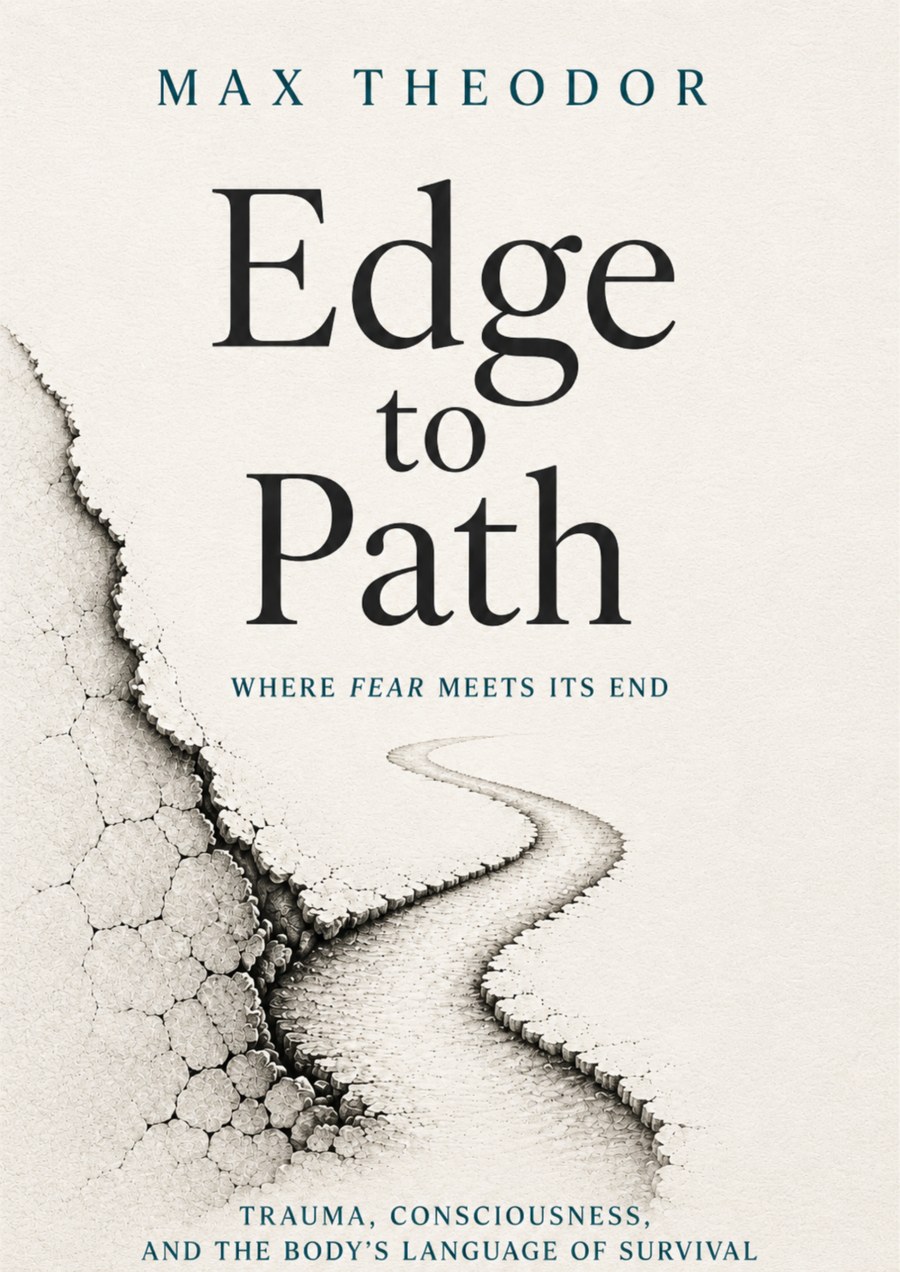
Read Edge to Path
Edge to Path follows the moments before, during, and after a familiar response takes over. First-person testimony and recurring case narratives sit alongside trauma neuroscience, somatic practice, and Tom Campbell’s MBT. [1]
Its question reaches beyond feeling different during a practice: what helps a person respond differently when the next difficult moment arrives?
Ebook · US$12.99
Sample the writing in the free chapter, or explore the Field Guide’s questions alongside the book.
Sources and distinctions
The book’s testimony, case narratives, clinical models, and author synthesis are different kinds of material. Sarah’s story illustrates the book’s argument; it does not establish a treatment result. The studies cited here test specific interventions.
Max Theodor. Edge to Path. 2026. Relevant sections: How to Read This Book; The Door; The Observer Within Reach; A Field Guide to the Edge; Guidance and Resources; Notes and Sources; Glossary. Explore the book.
↩1 ↩2 ↩3 ↩4 ↩5 ↩6 ↩7 ↩8 ↩9 ↩10 ↩11 ↩12 ↩13 ↩14 ↩15 ↩16 ↩17 ↩18 ↩19 ↩20 ↩21 ↩22 ↩23 ↩24 ↩25 ↩26 ↩27Peter Payne, Peter A. Levine, and Mardi A. Crane-Godreau. “Somatic experiencing: using interoception and proprioception as core elements of trauma therapy.” Frontiers in Psychology. 2015;6:93. A clinical-model account, not an efficacy trial. Read the article.
↩1 ↩2 ↩3 ↩4 ↩5 ↩6 ↩7 ↩8Danny Brom and colleagues. “Somatic Experiencing for Posttraumatic Stress Disorder: A Randomized Controlled Outcome Study.” Journal of Traumatic Stress. 2017;30:304–312. Read the study.
↩1 ↩2 ↩3 ↩4 ↩5Tonny Elmose Andersen and colleagues. “Somatic Experiencing® for patients with low back pain and comorbid posttraumatic stress symptoms – a randomised controlled trial.” European Journal of Psychotraumatology. 2020;11:1797306. Read the study.
↩1 ↩2 ↩3U.S. Department of Veterans Affairs, National Center for PTSD. “Overview of Psychotherapy for PTSD.” Summary of the 2023 VA/DoD guideline. Read the overview.
↩1 ↩2National Center for Complementary and Integrative Health. “Meditation and Mindfulness: Effectiveness and Safety.” Read the guidance.
↩1