
UNDERSTANDING TRAUMA
Trauma: what it changes, what it does not

Trauma can change how the body responds, what a person expects, and how they see themselves. A survival response can become so familiar that it feels like personality. Edge to Path asks how to understand that response without mistaking it for the whole person. [2,3,7]
An educational perspective from Edge to Path, not diagnosis or treatment. You can pause or leave the page at any point.
What is trauma?
Trauma can refer to a harmful experience or to the lasting effects it leaves. To understand it, we need to distinguish what happened, how the person experienced it, and what continued afterward. [1]
SAMHSA's trauma-informed definition includes events or circumstances experienced as physically or emotionally harmful or life-threatening, with lasting adverse effects on well-being and functioning. That is a broader frame than a single diagnosis. [1]
The event
What happened, including its severity, repetition, and whether protection or escape was available.
The experience
How the person encountered it, with their history, bodily condition, relationships, and resources.
The aftermath
What continued afterward in health, memory, trust, daily life, or access to support.
Trauma and PTSD are not the same thing
Post-traumatic stress disorder, or PTSD, is a specific diagnosis. It involves a pattern of symptoms after traumatic exposure, including re-experiencing, avoidance, changes in mood and thinking, and heightened arousal or reactivity. Duration, impact on daily life, and other possible causes are part of assessment. [2]
Not everyone who experiences a traumatic event develops PTSD. Many people recover after difficult reactions; others need support and treatment. Distress can also deserve attention without meeting the criteria for PTSD. [2,3,5]
What trauma can change
Bodily response
Startle, tension, a racing heart, or disrupted sleep can become part of daily life. A reminder may bring a strong physical response even when the person is trying to concentrate on something else. [3]
Attention and memory
Expectation and meaning
Relationships
Access to action
Sense of self
A repeated response can become a self-description: difficult, distant, weak, controlling. Edge to Path asks what is lost when that description becomes the whole account of a person. [7]
Why similar events can leave different effects
Similar exposure does not mean the same set of conditions. Earlier experiences, features of the event, subsequent stress, and the availability of support are among the factors considered in PTSD risk and recovery. No single factor determines one person's future. [2,5]
Consider the difference between being offered help and being able to use it. An offer may be sincere, yet transport, money, time, or continued threat can prevent it from becoming practical support. Naming a route is different from making that route usable.
Edge to Path keeps this distinction in view. What the person could understand, what their body could carry, and what their circumstances allowed may have differed from what an observer could imagine afterward. [7]
Different outcomes are not a ranking of courage, character, or worth.
When survival gets mistaken for identity
One of Edge to Path's central questions is what happens when a response becomes a self-description. A person who learned to watch for anger may call vigilance “just my nature.” Someone who learned to stay agreeable may experience every refusal as evidence of selfishness. [7]
These are possibilities, not conclusions about someone else. Kindness can be a choice, reserve a preference, and planning a useful skill. A behavior alone does not reveal its history.
An entire vocabulary of survival, mistaken for identity.

Text and meaning of the illustration
The left portrayal is dark and folded inward; the right is more upright and contains a landscape. The left text reads “Survival adaptation: Protection. Vigilance. A narrower view. A way through.” The right reads “Identity: Depth. Connection. A wider horizon. More than survival.” The contrast is symbolic. It does not rank people by posture, establish separate selves, or depict a required recovery outcome.
Trauma can change a person's experience and sense of self. We can acknowledge those changes without imagining a perfect self untouched by injury, or letting one response stand for an entire life.
Protection may be part of that life. So are relationships, tastes, abilities, commitments, humor, and the things the person cares about. Understanding an adaptation need not require rejecting everything it helped them become.
What trauma does not automatically explain
Before a body response is explained through history, the present situation still needs attention. A threat may be current. A workplace may be punitive. Illness, an injury, a medication effect, or exhaustion may be contributing to what the person feels. [7]
The body's alarm cannot by itself settle which explanation is right. Feeling settled cannot certify safety either. [7]
Reflection must not become a way to endure ongoing harm more efficiently. Depending on the circumstances, a person may need distance, medical care, advocacy, practical help, or a change in the situation itself. [7]
“The body gives the first report, not the final verdict.”
Edge to Path
Why understanding can arrive before change
Being able to explain a reaction later is different from being able to shape it while it is happening.
Research on stress and the prefrontal cortex shows that acute, uncontrollable stress can impair working memory and the regulation of attention. This helps explain why knowing something and being able to use it under pressure can diverge. It does not establish that everyone loses all capacity under stress. [4]
Sometimes the missing part is a response that needs practice or support. Sometimes it is permission, money, time, or safety. More explanation cannot supply each of those.
The question becomes more precise: what would have made that action usable for this person, under those conditions? In Edge to Path, that is the difference between listing an option and asking what was genuinely reachable. [7]
Where the Edge enters
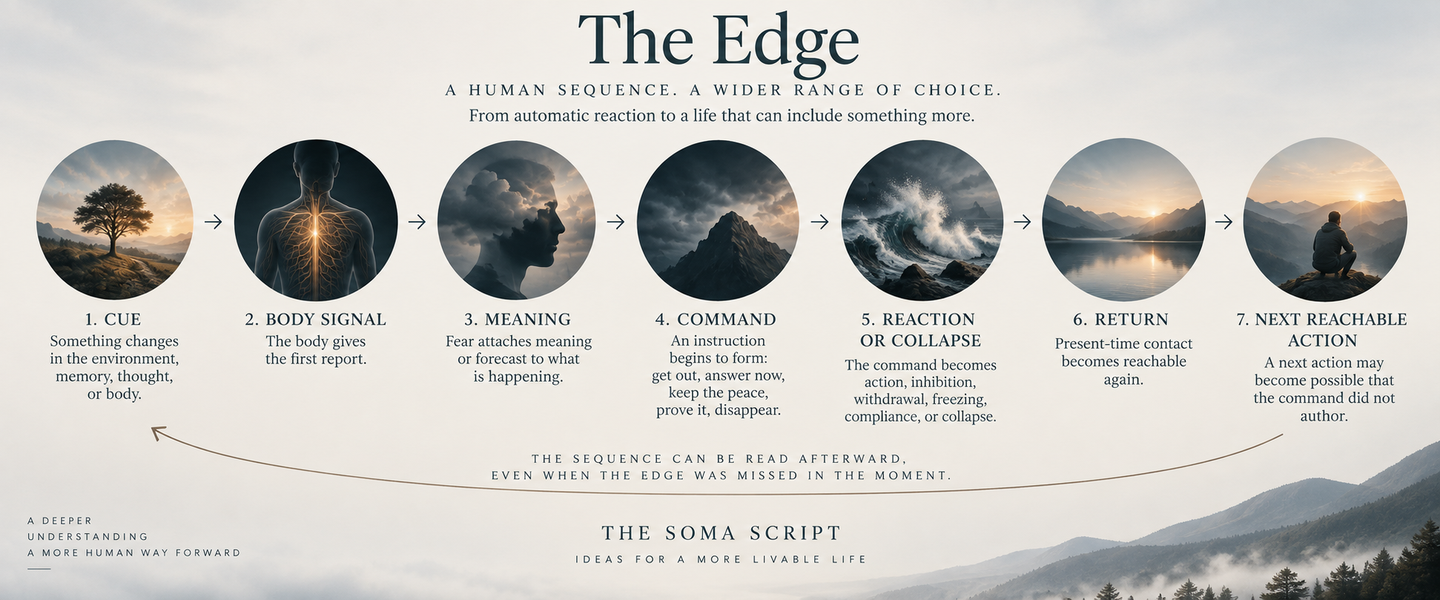
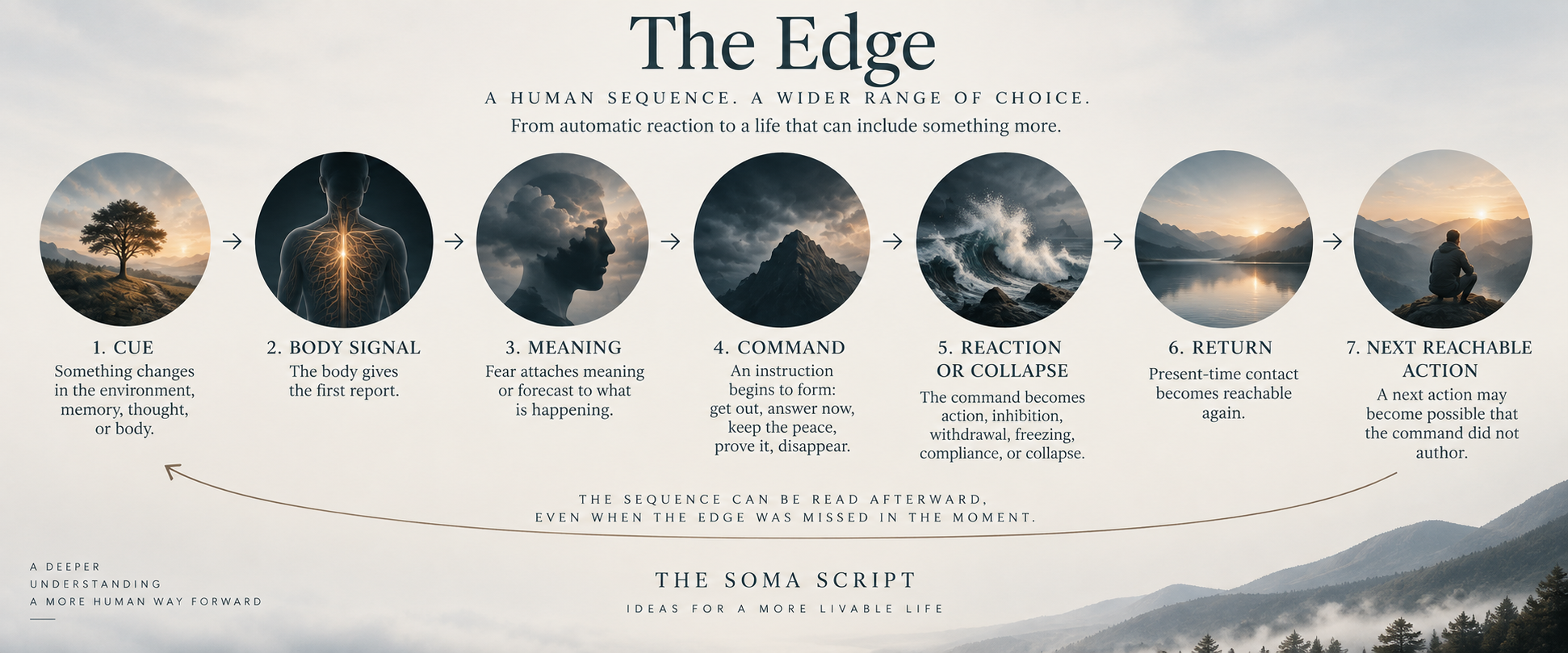
The Edge is the book's name for a narrow, conditional interval: a fear-written response has begun, while enough present-time awareness remains to influence what follows. It is an author-developed concept, not a diagnosis or a measured brain state. [7]
The interval can be missed. Much of the Field Guide's work happens afterward, when enough present-time contact has returned to look back. A next action may become reachable, but a pause or an insight does not guarantee it. [7]
The seven Field Guide questions
The same map in readable text, using the Guide's questions. [7]
CUE
What was the cue?
BODY SIGNAL
Where did the body speak first?
FEAR MEANING
What meaning did fear attach?
COMMAND
What command did it give?
REACTION OR COLLAPSE
What reaction or collapse began?
RETURN
What helped me return?
NEXT ACTION
What next action became reachable?
An answer can remain blank. The sequence is a way to examine an experience, not to reconstruct a complete memory or grade a response. The Guide can wait when reflection is unavailable or unwelcome. [7]
Text and meaning of the illustration
Seven circular images are linked from left to right: a tree, a stylized body, a face with clouds, a mountain, a breaking wave, a lake, and a seated figure. Their labels are Cue, Body Signal, Meaning, Command, Reaction or Collapse, Return, and Next Reachable Action. A curved arrow points back across the sequence. The central message is that the sequence can be read afterward, even when the Edge was missed in the moment.
In this reflection map, a cue is a change inside or around a person; a bodily signal is the report the person notices; fear-attached meaning is the interpretation or forecast; and a command is the instruction that begins to form. Reaction or collapse describes what followed. Return refers to present-time contact becoming available again. A next action may become reachable. The illustration's brain-and-body imagery is symbolic, and its wider-choice language is a possibility, not a guaranteed result of return or awareness.
A work message. An unsent reply.
In the fictional example, a person reads an ordinary request to review a draft as criticism of their ability. They record the reaction later. The example shows a possible pattern, not a PTSD diagnosis or a treatment result.
See the worked exampleNo installation, account, or personal entry is needed to read the example.
Read more about the EdgeWhat meaningful change can look like
Trauma-related difficulties can improve. For PTSD, treatments with substantial research support include Cognitive Processing Therapy, Prolonged Exposure, and Eye Movement Desensitization and Reprocessing. A qualified clinician can help assess needs and discuss appropriate options. [6]
Educational reflection and somatic practices have different purposes and evidence bases. The book and Guide are not substitutes for indicated treatment or practical safety. [7]
Within Edge to Path, meaningful change also concerns daily life: a reaction that runs less far, a conversation that becomes possible, a boundary that can be sustained, or time available again for rest and enjoyment. These are examples of what someone may value, not promised results of reading the book. [7]
A helpful moment can be valuable without proving that the change will last. We still need to see what remains possible later, in daily life. Continued support can be part of lasting change.
Understanding why a reaction arose also leaves its effects on other people intact. Accountability may include repair, changed behavior, or respect for a boundary. Forgiveness and renewed contact belong to the affected person, not to a model of healing. [7]
Questions before you continue
Do I need a trauma diagnosis to read Edge to Path?
No. The book also examines familiar patterns of fear, meaning, and reaction. That wider relevance does not mean every frustration, habit, or difficult choice is evidence of trauma.
Do I have to revisit a painful event to use this page?
No. You can read the explanation and fictional example without supplying a personal story. This page contains no exposure exercise. You may skip material or stop at any point.
Is the Field Guide a form of treatment?
No. It is a free, optional reflective companion for looking back after a reaction. It cannot assess your mental health or determine whether a situation is safe, and it does not replace individualized care.
[7]
CONTINUE WITH EDGE TO PATH
Follow the idea into the book
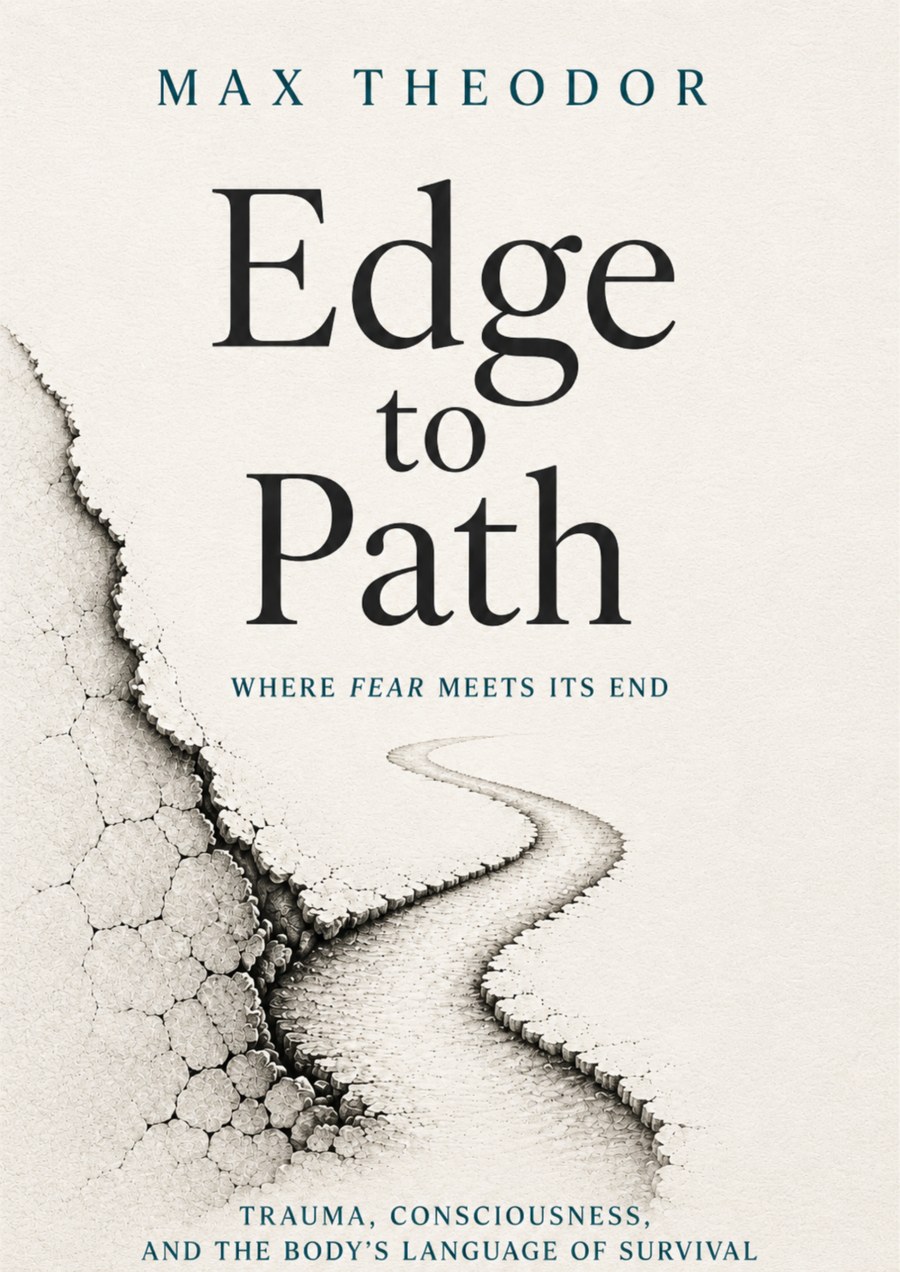
Edge to Path follows fear from the first bodily signal into the words, decisions, and relationships it can shape. It asks how survival can come to feel like personality, and what may make a different response possible.
The book brings neuroscience, somatic practice, and Tom Campbell's My Big TOE, or MBT, alongside one another. They remain different kinds of explanation. Neuroscience is not used as proof of MBT, and readers can examine the work without accepting its consciousness framework. [7]
Sources and perspective
The clinical overview draws on the public resources and research below. The Edge, Path, and the organization of the Field Guide are Max Theodor's synthesis in Edge to Path, rather than diagnostic categories or a validated treatment sequence. [7]
The discussion of identity, usable action, and accountability also contains the author's explanatory and ethical interpretation. Citing clinical research does not establish the effectiveness of this book or app.
Substance Abuse and Mental Health Services Administration. Trauma and Violence. Broad trauma-informed definition. An accessible federal explanation is also provided by Head Start in Defining Trauma.
National Institute of Mental Health. Post-Traumatic Stress Disorder. Diagnosis, symptoms, risk and support.
U.S. Department of Veterans Affairs, National Center for PTSD. Common Reactions After Trauma. Reactions, variability, and when to seek help.
Arnsten, A. F. T. (2009). Stress signalling pathways that impair prefrontal cortex structure and function. Nature Reviews Neuroscience, 10, 410–422. Stress and the use of higher-order cognitive capacities.
U.S. Department of Veterans Affairs, National Center for PTSD. PTSD Basics. Exposure, differences in risk, symptoms, and recovery.
U.S. Department of Veterans Affairs, National Center for PTSD. Talk Therapy. Research-supported PTSD psychotherapies.
Theodor, Max. Edge to Path: Where Fear Meets Its End. The Soma Script LLC, 2026. See Important Note to Readers, How to Read This Book, Mistaken for Character, The Edge, The Relational Field, The Ghost, and A Field Guide to the Edge.