
THREAT, MEMORY & RESPONSE
Neuroscience of Trauma: Why a response can persist.
Knowing why you react can be easier than responding differently. Explore how memory, learned expectations, and stress shape that difficulty in Edge to Path.
Educational reading. Includes a brief account of distress during a hospital visit.

Knowing and being able
After a difficult conversation, the answer you wanted to give may seem obvious. It was harder to find while someone was waiting for you to speak. This familiar contrast illustrates a question Edge to Path keeps returning to: what was within reach while the response was happening? [1]
Stress research helps explain part of the difficulty. Keeping information in mind and changing an approach are functions that can become less reliable under acute stress. An explanation reached afterward does not tell us how available those capacities were during the event. [4, 5]
Trauma-related reminders add another complication. An object, a phrase, or a situation associated with an earlier event can bring distress into a later one. In PTSD, re-experiencing can include the sense of reliving the event and physical signs of stress. A familiar reaction alone is not enough to establish that diagnosis. [2]
Having an explanation is valuable. Using it in a difficult moment asks something further of the person and the circumstances around them.
A visit to a friend
FROM STILL RUNNING
An orderly pushed a metal cart past and the hallway telescoped. One glimpse of IV tubing and I wasn’t there anymore.
Max Theodor, Edge to Path, “Still Running.” [1]

Memory and the use of context
A piece of equipment is only one part of a hospital visit. There are also the people present, the purpose of the visit, and what is happening around it. The distinction is between encountering a reminder and being able to use the rest of the situation to understand it.
Sarah Garfinkel and colleagues studied that use of context in people with PTSD and combat-exposed controls. Participants learned about a cue in different settings, then encountered it again the following day. The PTSD group made less use of contextual information in both the safety and danger conditions. The result was not simply stronger fear everywhere. [3]
This was a controlled laboratory task, not a reproduction of anyone’s traumatic event. Its contribution is specific: the presence of contextual information and its effective use can come apart. [3]
In the book, “filing” is the author’s metaphor for experience acquiring time, place, sequence, and an ending. The source notes qualify that image: these functions involve distributed processes, rather than one brain structure stamping a date onto a memory. They also acknowledge variation in traumatic memory. A vivid or coherent account should never be treated as evidence that the distress is less real. [1]
What stress can make harder
The prefrontal cortex helps keep information in mind and guide behavior in relation to a goal. Amy Arnsten’s work describes how sensitive this functioning is to stress-related changes in brain chemistry, especially under uncontrollable stress. That gives us an account of impaired functioning without imagining that the thinking brain has simply switched off. [4]
A meta-analysis by Grant Shields and colleagues found that acute stress tended to impair working memory and cognitive flexibility. Its findings on inhibition were more complicated, with different results across types of task. The evidence does not support treating all forms of control as one capacity that stress removes. [5]
These are useful connections between research and daily experience, not a way to infer someone’s capacities from their expression or behavior. Acute-stress findings also do not provide a complete account of PTSD. [1, 5]
Stress involves the body as well as the brain. Bruce McEwen’s account of allostatic load describes the cumulative cost of adaptation across interacting systems. The physiology includes two-way communication, not just an order sent from the brain to a passive body. It is broader than a claim that one stress hormone stays high. [6]
Understanding these constraints leaves another person’s experience of a harmful response intact. Edge to Path keeps explanation alongside protection, accountability, and repair. [1]
What the next moment is expected to mean
Consider a delayed reply. The delay is observable. “I have been rejected” adds an interpretation. The example leaves a gap between what has happened and what it is taken to mean.
One theoretical account helps frame that distinction. Nim Tottenham and Anna Vannucci propose that attachment schemas, shaped through early caregiving, may contribute to predictions relevant to emotion regulation. They describe their perspective as speculative, informed by converging research rather than established as a complete mechanism. [7]
Edge to Path draws on that proposal in “The Reality Map,” where earlier expectations enter later relationships. A delayed message on its own establishes neither a trauma history nor the other person’s intentions. [1, 7]
An expectation can be mistaken. It can also fit the present. Understanding its history should leave the current evidence open to examination, including evidence of real mistreatment. [1]
Reading brain research carefully
A brain difference found after trauma does not, on its own, tell us when or why that difference arose.
In a study of identical twins, Mark Gilbertson and colleagues found smaller hippocampi in veterans with severe PTSD and in their co-twins who had not experienced combat. That pattern pointed toward a pre-existing familial vulnerability in this sample, challenging a simple explanation in which the observed difference was entirely caused by combat. [8]
It does not follow that all brain differences predate trauma. The distinction is methodological: an association needs more evidence before it becomes a causal history. Nor does a group finding determine one person’s future. [8]
What change can involve
The persistence of a response does not settle how much can change with effective help. The VA’s overview of the 2023 VA/DoD guideline identifies Cognitive Processing Therapy, Prolonged Exposure, and Eye Movement Desensitization and Reprocessing, or EMDR, as recommended individual trauma-focused psychotherapies with strong treatment evidence. [9]
These treatments do more than offer an explanation. Depending on the approach, the work may involve examining meanings attached to an event or approaching reminders within a structured treatment. This is different from asking someone to face distress alone or treating reassurance as sufficient. [9]
A treatment result and a mechanism are different claims. Improvement does not, by itself, establish that a memory has been erased or that one process explains every successful treatment. Choosing care also involves the person’s needs, preferences, and available options. [1, 9]
The book follows change into ordinary life: a conversation answered differently, an action becoming possible, or a return found sooner. These are its narrative and practical concerns, not clinical outcomes demonstrated for Edge to Path. [1]
Where danger continues, practical protection and changes in circumstances belong alongside attention to symptoms. An inward explanation cannot make an unsafe situation safe. [1, 2]
Where the book takes the question
Edge to Path calls the interval in which activation is underway while awareness can still participate the Edge. This is the book’s synthesis, rather than the name of a brain region or a diagnostic category. [1]
Neuroscience contributes to understanding constraints within that interval. Somatic practice addresses experience through sensation, movement, and support. Tom Campbell’s MBT supplies a separate consciousness framework. The book places these accounts beside one another without using neuroscience as proof of MBT. [1]
Reading and support
This page offers education, not diagnosis or a trauma-processing exercise. You can leave a passage and return later. Persistent distress deserves appropriate support; new or medically concerning physical symptoms need medical assessment rather than an assumed trauma explanation. [1, 2]
Questions about trauma neuroscience
Does everyone who experiences trauma develop PTSD?
No. Responses and outcomes vary, and many people recover from their initial symptoms over time. PTSD has specific diagnostic requirements. Recognizing part of an example here is a reason to explore a question, not a diagnosis. [2]
Can a brain scan explain my reactions?
The studies discussed here investigate particular processes or compare groups. They do not supply an individual explanation of your reactions. Concerns about symptoms need an assessment that considers your history, health, and current circumstances, rather than an interpretation of a research image. [1, 2, 8]
Can a body response tell me whether a situation is safe?
It can provide important information, but it cannot settle that question by itself. A response may carry earlier learning; it may also be responding to current danger or another cause. Edge to Path keeps bodily experience alongside the facts of the situation, rather than making either alarm or calm a guarantee. [1]
Do I need to accept MBT to read the book?
The book invites skepticism. Tom Campbell’s My Big TOE, or MBT, is presented as a consciousness framework alongside neuroscience and somatic practice. It is not established by the studies on this page. Readers can examine the empirical material without accepting that ontology. [1]
Read Edge to Path
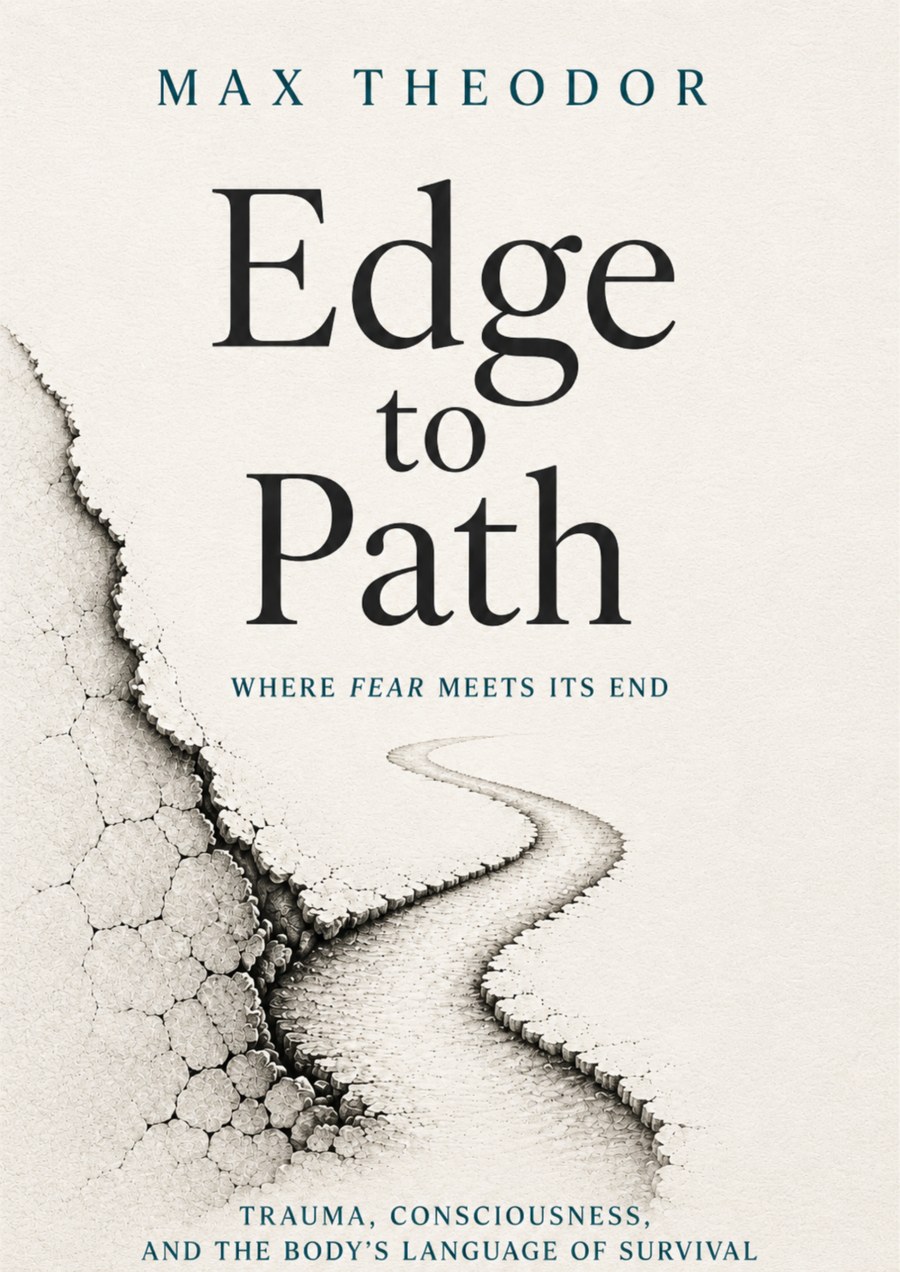
Edge to Path moves between first-person testimony and recurring case narratives, asking how a survival response can become mistaken for identity and what helps a different action come within reach. Its neuroscience, somatic, and consciousness perspectives remain distinct. [1]
Start with the free chapter to meet the writing, or explore the Field Guide’s questions alongside the book.
Ebook · US$12.99
Sources and distinctions
The hospital passage is the author’s testimony. The conversation and delayed-reply examples are illustrations, not case reports. Laboratory findings, theoretical proposals, clinical guidance, and the book’s synthesis answer different questions. None of the studies cited here tested Edge to Path as a treatment.
Max Theodor. Edge to Path. 2026. Relevant sections: “Still Running,” “The Last Freedom,” “The Reality Map,” How to Read This Book, A Field Guide to the Edge, Important Note to Readers, and Notes and Sources. Explore the book.
National Institute of Mental Health. “Post-Traumatic Stress Disorder.” Public information on symptoms, reminders, assessment, treatment, and ongoing trauma. Read the guidance.
Sarah N. Garfinkel and colleagues. “Impaired contextual modulation of memories in PTSD: an fMRI and psychophysiological study of extinction retention and fear renewal.” Journal of Neuroscience. 2014;34(40):13435–13443. A laboratory study of context-dependent responding. Read the study record.
Amy F. T. Arnsten. “Stress signalling pathways that impair prefrontal cortex structure and function.” Nature Reviews Neuroscience. 2009;10:410–422. A review of stress-related prefrontal functioning. Read the article record.
Grant S. Shields, Matthew A. Sazma, and Andrew P. Yonelinas. “The effects of acute stress on core executive functions: A meta-analysis and comparison with cortisol.” Neuroscience & Biobehavioral Reviews. 2016;68:651–668. Inhibition findings require care about task definitions. Read the study record. See also Junhua Dang’s methodological commentary and Shields’s response.
Bruce S. McEwen. “Physiology and neurobiology of stress and adaptation: central role of the brain.” Physiological Reviews. 2007;87(3):873–904. Stress adaptation, allostatic load, and brain-body interaction. Read the article record.
Nim Tottenham and Anna Vannucci. “Attachment as Prediction: Insights From Cognitive and Developmental Neuroscience.” Current Directions in Psychological Science. 2025;34(3):195–206. An explicitly speculative theoretical perspective. Read the article record.
Mark W. Gilbertson and colleagues. “Smaller hippocampal volume predicts pathologic vulnerability to psychological trauma.” Nature Neuroscience. 2002;5(11):1242–1247. A twin study relevant to predisposition and causal interpretation. Read the study record.
U.S. Department of Veterans Affairs, National Center for PTSD. “Overview of Psychotherapy for PTSD.” Summary of the 2023 VA/DoD guideline and its treatment evidence. Read the overview.
In “Still Running,” this hospital visit belongs to a later period of the author’s life. He is there to see a friend when a glimpse of the equipment brings his own surgery into the visit. The two occasions are separate, but his experience of them has drawn painfully close. [1]
This is first-person testimony. It makes the difficulty concrete without establishing that every trauma reminder works the same way. Research on memory and stress can help interpret the question; it cannot retrospectively measure this particular event. [1]