What Helped You Survive Can End Up Wearing Your Name
On the traits we take for personality, and what fear assigned them to watch

The pause between stimulus and response is real. Whether you can reach it depends on what your body is carrying.
You have seen it on therapists’ walls, in self-help books, on posters designed to look handwritten. Between stimulus and response there is a space, the familiar version says. In that space lies our power to choose our response, and in our response lies our growth and our freedom.
Viktor Frankl never wrote it.
The Viktor Frankl Institute treats the passage as an alleged quotation with an unresolved origin, and traces much of its spread through Stephen Covey, who recalled finding something similar in a library book and never wrote down the author or the title. The words are absent from Man’s Search for Meaning and The Doctor and the Soul, and no one has located them in his published lectures. A closer formulation belongs to Rollo May, who wrote in The Courage to Create about the human capacity to pause between stimulus and response and, inside that pause, to choose which response to throw our weight behind. May tied that freedom directly to consciousness and self-awareness. Frankl’s own authenticated language runs harder and stranger. He wrote about what he called the last of the human freedoms, the freedom to choose one’s attitude in any given set of circumstances.
The misattribution held because the idea sounds like him. Close enough to his life’s work that people stopped checking.
The attribution is the smallest thing wrong with the quotation.
What happens next is the real trouble. The idea becomes an instruction. Trigger, pause, choose. It gets handed across desks and printed on cards and taught as though the pause were furniture, standing in every room, available to anyone willing to walk over and use it. Fail to find it and the explanation defaults to character. You did not want it badly enough. You did not practice enough. You are not far enough along.
Someone’s tone drops and your answer is already out of your mouth. By the time you hear your own volume, the edge is in the sentence, sharper than anything you would have chosen if awareness had caught up in time. Or the opposite happens. Language stalls. Your collar goes hot, your hands stay flat in your lap, and you watch yourself retreat behind your own eyes, past the place where the person who needed you could find you.
You went looking for the pause. It had already closed.
Twenty minutes later the alternatives are obvious. You could have asked what they meant. You could have left the room. You could have stayed quiet without shutting down. You could have said the one sentence you had rehearsed a hundred times. From the far side, the interval looks enormous. Inside it, there may have been almost nothing.
Whoever lists those options afterward is holding something the one inside the reaction was not. What separates them is access rather than character.
The consciousness framework I work from, physicist Tom Campbell’s My Big TOE, gives this territory a name. Decision space, in the way I use it, means the choices consciousness can actually reach and use inside the living moment, as distinct from the list a settled mind can generate afterward with its hands back in its lap.
Sitting on a couch on an ordinary Tuesday, you can produce ten responses to a difficult sentence. Short on sleep, carrying an old fear that a familiar tone has just touched, you may be able to reach one. The other nine exist. Nobody declined them. They were out of reach.
Hindsight hides this, because hindsight restores access. Once the body settles, language returns. Context comes back. You can see the other person again instead of only the threat your body was reading, and the response that felt inevitable becomes hard to understand from outside it.
At the level of the organism, part of this is chemical.
Amy Arnsten’s research at Yale describes a prefrontal cortex that does its best work inside a narrow band. Moderate norepinephrine and dopamine keep it tuned to hold alternatives in view and keep reflex under restraint. Under acute, uncontrollable stress, those same chemicals climb past the useful range, and the connections that hold context available begin to lose their grip. Faster circuits take the lead. Resemblance arrives ahead of context. What the body has rehearsed is what the body offers.
The body may also be carrying older information forward. The tone of voice was real. The face really did change. Someone really did go quiet. A nervous system shaped by earlier threat can move from that true signal to a much larger conclusion, and by the time thought catches up, the conclusion has the weight of something you witnessed rather than something you built.
This is abandonment. This is danger. Stop it now.
None of this makes the body a machine running a program. It does mean the conditions the pause depends on are physical, and physical conditions change.
Neuroscience describes what the organism is doing. Its methods are not built to say what consciousness can still receive while that is happening, and the popular instruction quietly assumes an answer to exactly that question.
In Edge to Path, working from Campbell’s framework, I call that capacity the Observer: consciousness able to witness what is moving through it without becoming identical to it.
The gap is the interval in which a response can still change. Observer access is what lets you stand inside that interval instead of being carried by it. As fear rises, that access narrows. The distance between you and what is running through you closes. You are still looking at a face across a table, four feet away, and there is no longer any part of you standing anywhere else.
That is why the closing feels total. Less like losing a skill. More like losing the self that would have used the skill.
What returns is access. The capacity was never destroyed. The floor under it fell away, and when the body regains ground, consciousness can receive fear as content again instead of living inside it.
This is where Frankl becomes useful in a way the poster cannot hold.
He did not walk into the camps as a blank slate and discover human freedom by force of will. Years of psychiatric practice came first, and the development of logotherapy came first, and a working life already organized around meaning and responsibility came first. The deprivation was still total: hunger, cold, illness, exhaustion, and lack of sleep. Surviving it still cost him everything it cost. What the preparation changes is the comparison a reader is quietly invited to make.
So the useful question is not why you failed to find the space when it mattered. It is what makes more of that space reachable before the pressure arrives. Only one of those can be answered by trying harder in the moment.
The first time you recognize the sequence, the damage is already done. You hear your own sentence after it lands. You watch the face across from you change. Awareness came back too late to redirect anything, and seeing it at all is different from seeing nothing.
Then recognition comes thirty seconds earlier. Then while your voice is still changing. Then, in some moments, the body gives its first report and something in you catches it before the command finishes.
That is a smaller measure of progress than the poster promises, and you can check it against your own week.
There is an obvious way to misuse this argument.
Explaining the speed of a reaction does nothing for whoever was standing in front of it. A narrowed decision space is an account of conditions, and an account of conditions buys nothing forward. Understanding where a pattern came from can lower shame, which matters, because shame is one of the reliable reasons people never begin the work at all.
Responsibility starts where access returns, and it looks like ordinary work. Protecting people from a repeat. Repairing what can be repaired. Changing the conditions that keep the reaction loaded. Leaving a situation before the same sequence reaches someone else.
The person who was harmed is never required to stay nearby while any of that happens.
The gap is conditional. Accountability is not.
The interval where the body has begun answering from fear, while enough of the present may still be within reach to change what happens next, is what I call the Edge. The poster promises the pause from outside, after the fact and at full width. The Edge is the same ground met from inside, and it does not stay the same width from one evening to the next.
Nobody works their way to a life without reactions. Some nights the whole of the work is a hand staying open on the steering wheel while the sentence you had ready goes unsaid, and the person in the passenger seat never learns how close it came.
Viktor Frankl Institute. “Alleged Quote: Between Stimulus and Response.” ViktorFrankl.org.
Quote Investigator. “Between Stimulus and Response There Is a Space. In That Space Is Our Power to Choose Our Response.” February 18, 2018; updated March 23, 2025.
May, Rollo. The Courage to Create. Norton, 1975; Norton paperback, 1994. Chapter 5, “The Delphic Oracle as Therapist.”
Frankl, Viktor E. Man’s Search for Meaning. Beacon Press editions.
Arnsten, Amy F. T. “Stress Signalling Pathways That Impair Prefrontal Cortex Structure and Function.” Nature Reviews Neuroscience 10 (2009): 410–422. doi:10.1038/nrn2648.
Campbell, Thomas W. My Big TOE: Awakening, Discovery, Inner Workings. Lightning Strike Books, 2003.
Theodor, Max. Edge to Path: Where Fear Meets Its End. The Soma Script LLC, 2026. thesomascript.com.
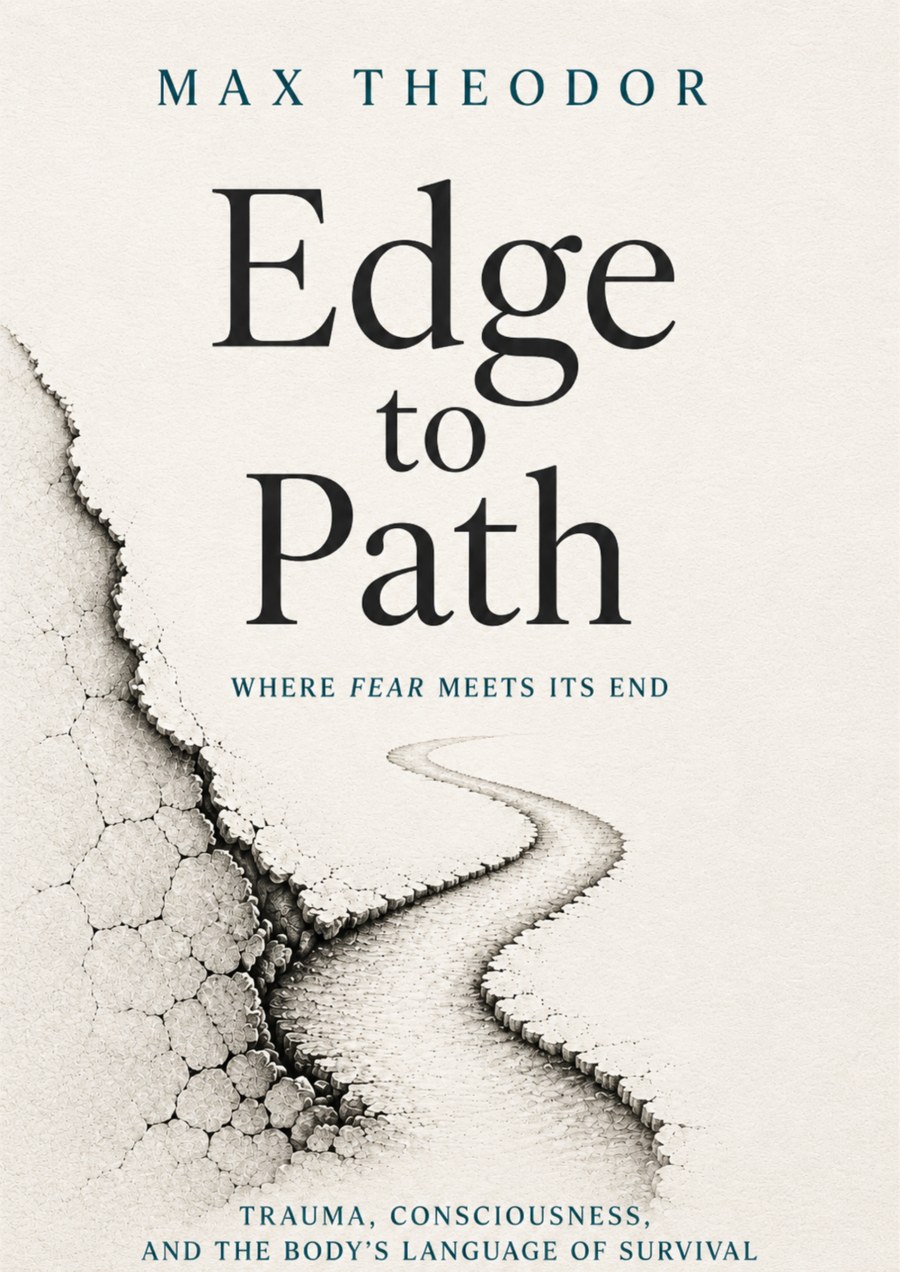
Before fear becomes your next move, there is an Edge. Edge to Path follows that interval: old protection is moving, and awareness has not yet been overtaken.
On the traits we take for personality, and what fear assigned them to watch
There is a strange difference between knowing something and having it become true in you.
Helplessness is a report on conditions. Recovery widens what is reachable now without pretending it was reachable then.
New essays are announced on Max Theodor’s Facebook page.