What Helped You Survive Can End Up Wearing Your Name
On the traits we take for personality, and what fear assigned them to watch

There is a strange difference between knowing something and having it become true in you.
Human beings have spent thousands of years producing teachings about how to live. Religions have built moral worlds around love, sacrifice, humility, forgiveness, and surrender. Philosophers have argued over virtue, freedom, suffering, and death, and teachers have handed down practices for loosening attachment and for becoming less afraid. A person can spend decades among those ideas and know them deeply, and mean them, and be able to explain them to others with care.
Then life happens, and the teaching changes form.
A book can explain forgiveness with perfect clarity, and then there is a face on the person who would have to be forgiven. Nonattachment makes sense until something you love begins leaving. Humility is easy to admire while no one is offering praise, and generosity can feel like a settled value until the giving costs. The idea is no longer a proposition that can be agreed with. Something is at stake in it, and whoever carries it is standing inside whatever is at stake.
This is why I have come to think of life as the only spiritual teacher that finally matters. A human teacher can still save years of confusion by giving language to what a person has felt and could not name. A tradition can preserve discoveries made across centuries and hand them to people who would never have reached them alone. Religion and philosophy transmit ideas, practices, maps, and an accumulated sense of what a good life is. What none of them can do is live the teaching for anyone. Every teaching is handed over, eventually, to the life of the person who received it, and that life is the only place it can be converted from what is known into what is. Wisdom has many sources. It has one place where it becomes a person.
Life has no doctrine of its own. It does not ask whether a person is Buddhist or Christian, an atheist or a mystic, whether they read the Stoics or Campbell or nobody at all. It brings the same raw conditions to people carrying different explanations of them: love appears, and so does jealousy; money enters; one person gains authority over another; a parent becomes dependent, a career begins to matter too much, a body ages, a plan fails, and a disappointment arrives at exactly the place where a person believed themselves generous. Then the philosophy has somewhere to go.
Before that moment, much of what we call truth is still borrowed. I can agree that possessions are temporary. I can repeat that control is an illusion and that resentment damages the person carrying it. Those ideas can be intelligent, coherent, and entirely sincere in me, and there is still a difference between a truth I can explain and a truth that has become part of the way I live. Life exposes that distance without needing to announce it. A person who values compassion discovers how conditional their compassion becomes when they feel betrayed. Years of speaking about surrender can turn out to have meant surrender so long as the outcome stayed acceptable. Status means little until someone else receives the recognition that was expected, and then the ground moves.
None of this makes the earlier philosophy fraudulent. It makes the philosophy unfinished.
That distinction matters to me because spiritual language so often turns these moments into accusations: the ego has returned, the person failed the test, they were less evolved than they imagined. What these moments show is simpler and more useful: where an idea ends and a lived truth begins. And the person is not the only one being tested. Sometimes the idea itself breaks. A teaching can be partial, or right only under certain conditions, or wrong, and the situation that shows it is the same kind of situation that shows the person; an acceptance that was right for one loss is wrong where action was needed. Contact with conditions can expose a philosophy, break it, or revise it, as it can the person who holds it.
Tom Campbell gives the central distinction unusually direct language in My Big TOE. He separates what he calls the intellectual level from the being level. The intellectual level is what a person thinks, and in particular the image they have of themselves and of the world, and a person can learn a great deal there, and even change that image, without the change reaching the level from which intent and quality arise. In his framework knowledge alone does not make the change; what has been learned has to become part of the being. That is close to what happens when a philosophy meets a life: the sentence leaves the book and acquires conditions. Patience meets delay, integrity meets advantage, and the person is no longer being asked what they believe. Their conduct has begun answering for them.
And this does not happen only through suffering. It is the easiest mistake to make when speaking about life as a teacher. Pain is dramatic, so hardship gets treated as the great spiritual school, and comfort can reveal as much. Success teaches, and so do power and being admired. Having enough money to stop thinking about money can expose more about a person than years of scarcity could, because scarcity can resemble frugality when the options are constrained, and obscurity can resemble humility when recognition has never been available to test it. Abundance and praise then show whether the apparent virtue survives once the constraint is lifted. It is one thing to believe that power should be used carefully while having none. It is another to have people begin saying yes because of your position. A person can find that wealth reaches a generosity scarcity never had the means to test, because now there is more to protect, and that praise reaches a humility obscurity had only sheltered. The unsettling version of this is that some of what passed for virtue was never tested at all; the opposite opportunity had not arrived yet. Another revealing condition is impunity, what a person does when no consequence follows. Life does not only take things away. Getting what was wanted can expose what the wanting concealed.
This is one reason philosophies survive for centuries while individuals go on struggling with the same human problems. The philosophy may be sound and the transmission accurate, and the difficulty comes later, when an idea that was understood in safety meets the conditions that reveal whether it has become part of the person.
Teachers keep their place in this. A teacher can help a person understand what an experience reveals, religion can give suffering a language large enough to think inside, philosophy can keep one difficult event from becoming the whole meaning of a life, and practice can prepare attention, discipline, courage, and patience before circumstances demand them. Practice is a protected slice of life rather than a substitute for it, conditions chosen in advance, where formation begins. What practice cannot do is carry that formation into the conditions that cannot be rehearsed, and those are where the teaching has to go: out of the temple, the church, the meditation cushion, the lecture hall, the book, and into a marriage, a business, a hospital, a friendship, an argument over money, an ordinary afternoon when no one is thinking about spirituality at all. A map is still waiting for terrain. That is where we find out what traveled with us.
The traditions know this about themselves, and so I do not think I am saying anything against them. Epictetus told his students not to call themselves philosophers and not to display their principles but to act from them, and he warned about the danger of throwing up what had not been digested; sheep, he said, do not bring up the grass to show the shepherd how much they have eaten, they digest it and produce wool and milk. The Letter of James tells its readers to be doers of the word and not hearers only, deceiving themselves. A Stoic and an apostle, in different vocabularies, give the same warning from inside: hearing the teaching, even repeating it well, is not having it. Life is where the traditions themselves send the teaching to become conduct. I am taking them at their word.
The same thing explains why certain ideas fail exactly when they are most needed. A person can spend years studying equanimity and lose it in five minutes, and the immediate conclusion is that the teaching failed or the person did. There is another possibility. The idea had reached the intellect before it had become a way of being. That is not nothing. Understanding can be the beginning of enormous change; it can orient a life and tell a person what direction is possible. Sooner or later the conditions arrive that show whether the direction has become movement, and no teacher can answer that on anyone’s behalf.
None of this requires believing that the universe constructs a private syllabus for every person or sends suffering according to a hidden educational plan. That idea becomes cruel quickly. Violence remains violence, loss does not become good because the person later grows, and no one owes gratitude to what harmed them. Calling life a teacher does not require believing that any event was sent as a lesson. It means that whatever has happened now belongs to the life in which what a person believes will either remain philosophy or become lived. There is a difference between saying that suffering was necessary and saying that what has happened, once it has happened, is part of the life through which a person goes on becoming who they are. The first tries to justify the event; the second leaves it alone and asks what happens now.
And life is not automatically a good teacher. Experience teaches fear, cynicism, domination, and withdrawal as readily as it teaches wisdom, and people can live through a great deal and come out of it smaller. A tradition gives direction to the feedback; life gives reality to the tradition. Neither can do the other’s work. This is not life against teachers, or experience against philosophy. Life teaches the way gravity teaches a child to walk, without intention, by consequence, and what the child makes of the falling depends on what it has been given to make it with.
So what changes when a truth stops being borrowed? The truth itself does not change; it was true or false before I ever met it. What changes is my relation to it, and the change shows in recognizable ways. The truth governs when following it costs, and it governs when nothing external requires it any longer, which is what comfort tests. The want moves: a person who once did the right thing against their own desire, with a fight, begins to want it, and most of us live for a long time in the distance between those two; that distance is the ordinary shape of a life, and it is not an accusation. It changes what a person notices before it changes what they do.
A lived truth needs less defense and fewer quotations, and that last mark proves nothing by itself, since conviction has it too; what counts is the direction the conduct takes, toward less fear and more care, and whether it stands when it costs and when nothing requires it. Such a truth is partial, owned in one part of a life and borrowed in the next. It can be lost again under enough pressure. And the claim to have made a truth one’s own proves nothing either way, while the need to defend the claim may be a sign that an identity has formed around the teaching.
There are truths a person knows because someone explained them well, and there are others they know because the distance between the idea and the thing itself closed in the living. The second kind feel different. They can be harder to explain, because they have moved from what a person possesses as knowledge into what shapes how they meet the next moment. Before that, the teacher, the religion, the book, the system, all of them, are pointing toward the same unfinished place, and life is waiting there, without an examination paper or a score, with another day. Whatever we believed before that day arrived now has somewhere to become true.
Campbell, Thomas W. My Big TOE: Awakening, Discovery, Inner Workings. Lightning Strike Books, 2003; and the My Big TOE Glossary, “intellectual level” and “being level,” https://www.my-big-toe.com/theory/glossary/intellectual-level/ and https://www.my-big-toe.com/theory/glossary/being-level/. Accessed 19 August 2026.
Epictetus. Enchiridion, 46.
The Letter of James 1:22.
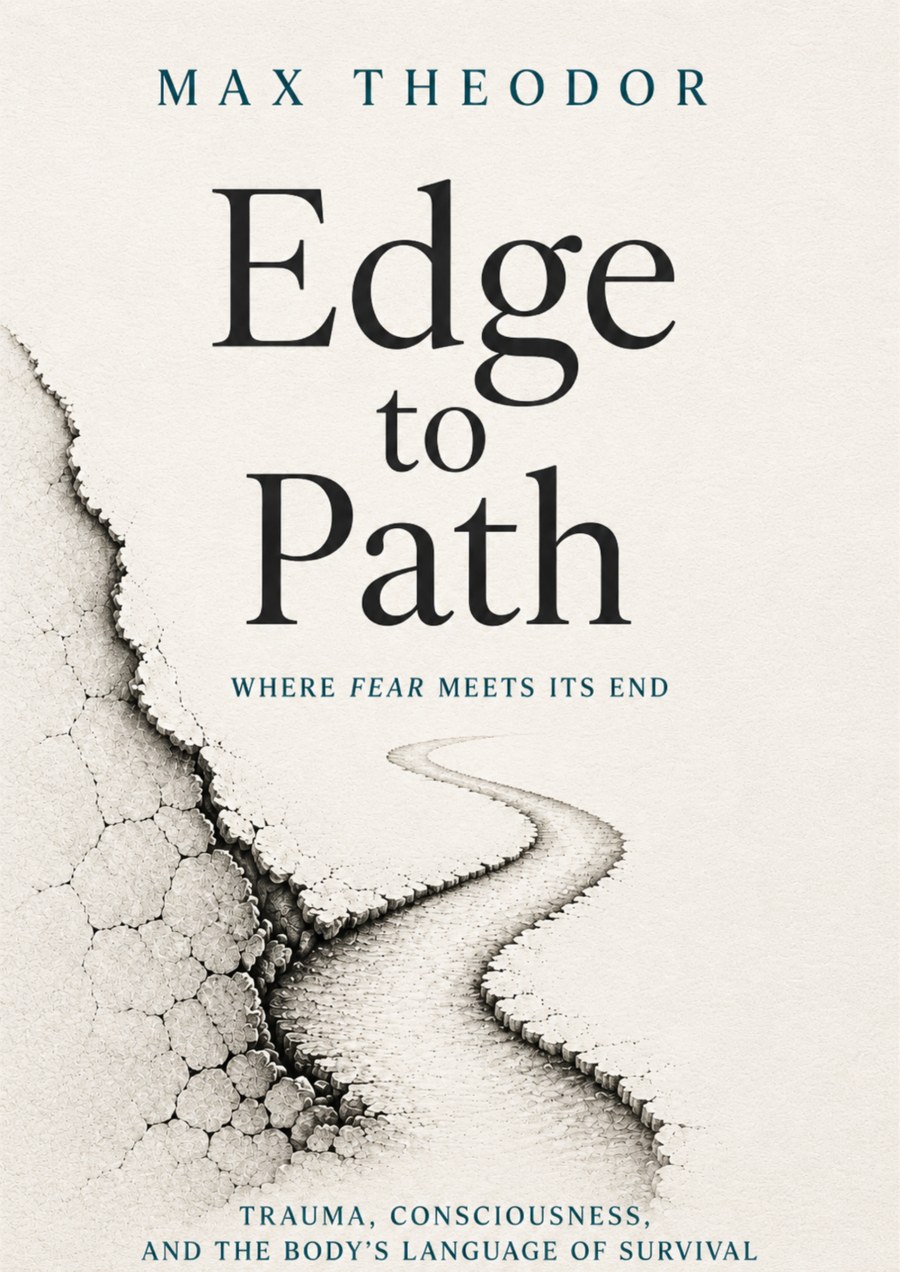
Before fear becomes your next move, there is an Edge. Edge to Path follows that interval: old protection is moving, and awareness has not yet been overtaken.
On the traits we take for personality, and what fear assigned them to watch
Helplessness is a report on conditions. Recovery widens what is reachable now without pretending it was reachable then.
The pause between stimulus and response is real. Whether you can reach it depends on what your body is carrying.
New essays are announced on Max Theodor’s Facebook page.