What Helped You Survive Can End Up Wearing Your Name
On the traits we take for personality, and what fear assigned them to watch

Helplessness is a report on conditions. Recovery widens what is reachable now without pretending it was reachable then.
The fluorescent light in the precinct buzzed. I was sixteen. An hour earlier I had been fixing a bike chain with a neighbor, grease on my hands, sun on the back of my neck. Then the police cars, and a word I did not yet know how to hold: murder. A case that needed closing fast, and two boys who would do. My cousin and me.
I explained. I was calm, and I had facts: where I had been, who had seen me. The first slap came in the middle of a sentence and took the sentence with it, along with the belief that this was a conversation. A fist under the ribs emptied my lungs. There was a silence in the chest where breath should have been. My legs stopped answering. Concrete. Cold. Someone kicked, and the impact arrived from far away, like news from a country I used to live in.
Then I was on the ceiling. Suspended near the light, looking down at a skinny boy with blood on his chin, jerking when they kicked him. Thick glass between us. Questions repeated until they were noise. Where were you. Who were you with. The truth came out again and again, and again and again it changed nothing.
I could not fight men with fists, and the door belonged to them, and nothing I said was going to be used. The room had one exit, and the body found it, upward and out, without consulting me.
Years afterward, when the memory surfaced, the ceiling came with it: a boy on concrete, me somewhere above him. My first reading was the one I had feared most. Evidence that I had snapped. Whatever had happened in that cell, there was a line between functional and finished, and I was sure I had crossed it.
The reading hardened into a sentence I stopped hearing because it never left. A stronger person would have handled it. Familiar enough to become invisible, like wallpaper I had stopped seeing. I froze. I did nothing. I left. My jaw tightened whenever the night came near, the body bracing around a judgment it had carried so long the judgment felt like fact.
That is how helplessness travels. It begins as a description of a room: no fight that could change the outcome, no door I could reach, no sentence with any leverage. It ends up as a description of a person. The conditions get promoted into character, and the promotion happens in the safety of afterward, in a body that can breathe.
For fifty years there has been a scientific term that, said aloud, sounds like that verdict. Learned helplessness. In the laboratory it was a hypothesis about whether an animal’s actions changed anything. Said across a kitchen table, it can sound like a character reference. The classic experiments put dogs, and later rats, through shock they could not stop and found that afterward, when escape was possible, many failed to learn it. The theory said they had learned that nothing they did mattered, and that the lesson followed them into the shuttlebox, where crossing the barrier would have ended the shock.
In 2016, two central architects of that theory, Steven Maier and Martin Seligman, revisited it with the neuroscience that had accumulated since, and reversed it. Their account now: passivity and heightened anxiety are the default response to prolonged aversive stimulation. That response was not learned. When control is available and detected, what gets learned is that a response changes what happens: a wheel turned, a shock that stops. That learned control recruits circuitry that quiets the passive response. In the original experiments, they now write, helplessness was not learned.
That is a finding from dogs and rats in laboratory boxes, and Maier and Seligman say so. The human brain work was thin when they wrote, and they say so: it gave the animal picture only some support. They call their ideas about treatment the most speculative thing in the paper. None of this describes what my nervous system did on that floor. What it does is take one thing off the table. In the experiment that gave the field its word, the animal that went still was not the one that had learned something wrong.
When fighting is impossible and fleeing is blocked, some bodies go lower. Below the surge, into shutdown: movement unavailable, sensation dimming, awareness at a distance from what is happening to it. Survival by disappearing.
Leaving my body was not malfunction. It was design, performing as intended when every other option had vanished. Fully present, I do not believe I would have survived it. My mind withdrew from what was killing me and kept the rest alive. How, I cannot say.
The clinical word, dissociation, landed years later, and it reframed the night. Not all at once. The verdict did not vanish, but its authority did. I am broken had lived in my chest so long I had mistaken it for anatomy. The shift, from I am broken to I was protected, cracked a tightness under the sternum I had not known was there.
Judith Herman put helplessness at the center of what trauma is. In Trauma and Recovery she describes traumatic events as ones that overwhelm a person’s ordinary sense of control, connection, and meaning, and she orders recovery accordingly: safety first, before the deliberate work of remembering and mourning, before reconnection. Some control comes early, over the body and then the surroundings, because nothing else can be built without it.
Her order matters here because it locates the work in time. Restoring agency is a task of recovery. The task says nothing about what agency existed in the room.
Which forces one distinction before anything about recovery can be said. If the danger is still current, or you cannot tell whether it is, the next step is outward. Assessment, support, a plan, protection, material change. A quiet body cannot certify safety. Money, housing, transport, someone watching a phone, legal conditions, a child who needs care, a disability that shapes every exit: these decide what is reachable in a way no breathing practice can. An exit can exist ten feet away and not be reachable, and nothing in this essay is permission to say to anyone in that position, you could have left.
Recovery, when the danger has ended, is the widening of what is reachable. Not the discovery that a choice was always there; that is the old accusation in a kinder voice. You can lift a bar. You can say the sentence in the room instead of an hour later. You can let someone sit near you without your chest closing. You can walk out a door because it is a door.
Mine ran through the body. I found a barbell and a yoga mat. No one prescribed them. Months in, I began to feel my body again, and each loaded bar, each held pose, let my body do what the cell never allowed: the whole surge, then the return. That was my route, not a prescription. It says nothing about anyone else’s.
In Tom Campbell’s framework, what a person can reach in a given moment is called decision space. It is the cleanest way I know to hold three things apart: the list a settled mind draws up afterward, what was reachable then, and what is reachable today. The first cannot enlarge the second. Recovery widens the third.
Later width creates present responsibility. The person I am now answers for what I do with what I can reach. It does not travel backward and become evidence against a boy who did not have it. What was not reachable was not refused.
The cell still comes back. It arrives in the chest first, the same place the floor gave way, a pressure under the sternum that used to close like a fist around the sentence.
Now the breath goes down to meet it. The ribs widen. The pressure is there, and nothing in me is bracing to be found guilty. The breath goes out, and the chest keeps its width.
Maier, Steven F., and Martin E. P. Seligman. “Learned Helplessness at Fifty: Insights from Neuroscience.” Psychological Review 123, no. 4 (2016): 349–367. doi:10.1037/rev0000033.
Herman, Judith L. Trauma and Recovery. Basic Books, 1992.
Campbell, Thomas W. My Big TOE: Awakening, Discovery, Inner Workings. Lightning Strike Books, 2003.
Theodor, Max. Edge to Path: Where Fear Meets Its End. The Soma Script LLC, 2026. thesomascript.com.
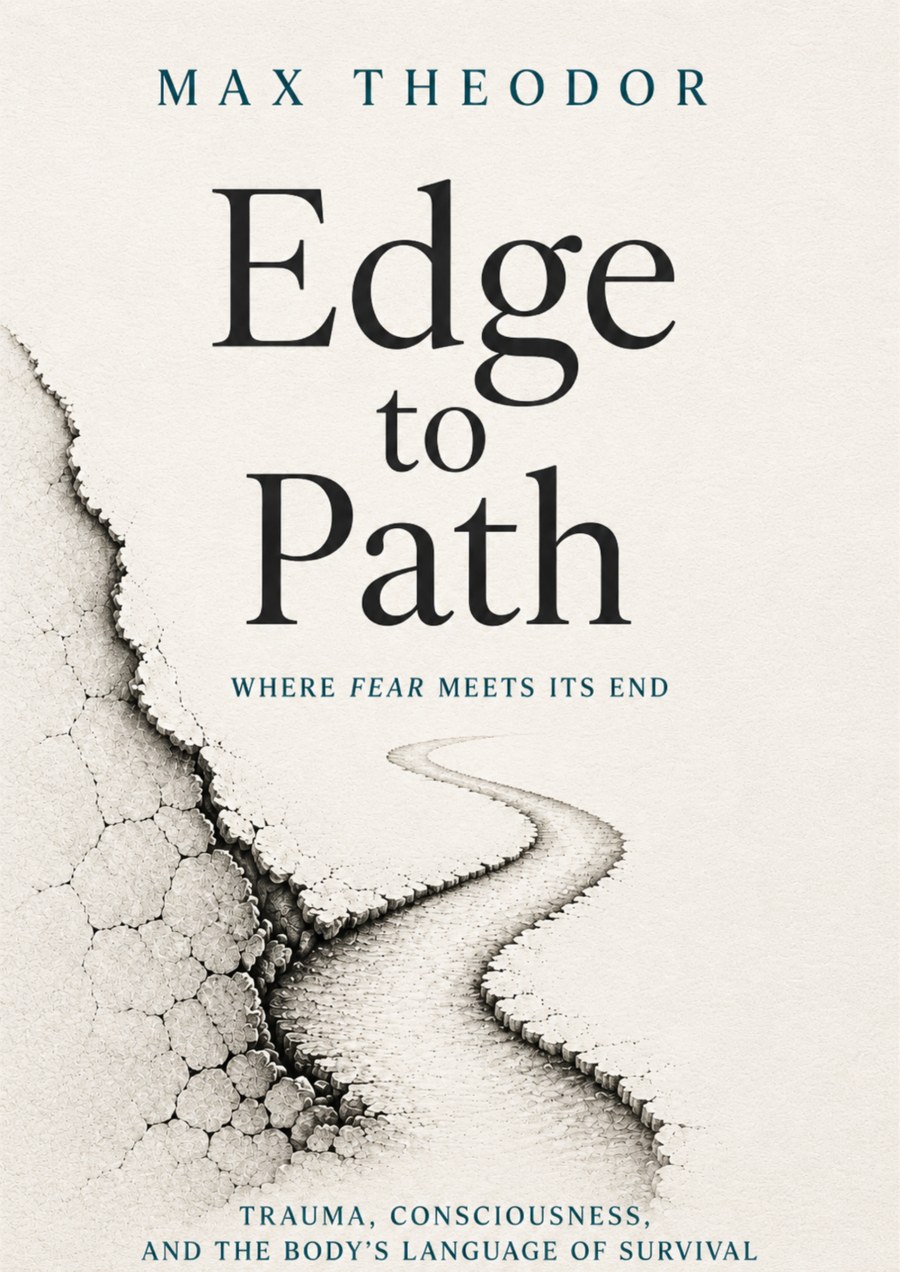
Before fear becomes your next move, there is an Edge. Edge to Path follows that interval: old protection is moving, and awareness has not yet been overtaken.
On the traits we take for personality, and what fear assigned them to watch
There is a strange difference between knowing something and having it become true in you.
The pause between stimulus and response is real. Whether you can reach it depends on what your body is carrying.
New essays are announced on Max Theodor’s Facebook page.