Your Only Spiritual Teacher
There is a strange difference between knowing something and having it become true in you.

On the traits we take for personality, and what fear assigned them to watch
The couple has been in the house for forty minutes, and Sarah can tell they are close. The wife keeps drifting back to the same window. The husband tests the hinge of a cabinet door the way people handle things they have decided to own.
Then he turns to Sarah and asks about the price. Nothing in the words is hostile. The register drops, that is all, and the vowels flatten into something firmer.
The body reads it before she does. Breath stops halfway down. The throat narrows by a degree, then by another. Hands she had not been thinking about are suddenly there, too visible, and she lets them find the counter.
She has the answer. She knows where the comparable sales on this street land and what the square footage comes to, and she has walked this objection through a hundred kitchens. The sentence is assembled and waiting.
Then it is gone.
She has made no decision. A door has closed on the sentence somewhere she cannot reach.
The face holds. The couple steps outside to talk, and the house sells a week later. Over lunch she tells a colleague about the showing, and by the end of the telling it has become a story about a tricky negotiation she handled well.
Sarah is the best reader of people in her office, top producer three years running. She can feel a buyer’s hesitation before the buyer says it and change course mid-sentence when a shoulder turns away across a kitchen island. The capacity that wins her listings is the same one that took her voice at that counter.
She is a composite, a figure I built for my book, and I know her pattern from the inside. For years I called my own scanning perceptiveness. I called the pressure behind my teeth concentration. Both names were close enough to the truth to keep.
Describe that afternoon online and someone will name it for her within minutes. The silence would be called a fawn response, and her gift for reading people hypervigilance. Both would be explained as trauma responses learned in a house where a man’s voice could change the evening.
There is a whole genre built on that move, and it has done real good. People who spent decades believing they were simply anxious, difficult, oversensitive, or weak have found a more accurate account of themselves in it.
It has also drawn a backlash. In 2024 a New Statesman columnist argued that familiar childhood dynamics were being rebranded as trauma, and that traits like putting others first are common and often have nothing traumatic behind them.
Both camps catch something, and both are asking Sarah the same question: is this you, or is this damage?
If Sarah’s perceptiveness is only a symptom, then one of the best things she does at work begins to look like damage. Getting better starts to sound like losing something useful.
But calling it simply a personality trait leaves the kitchen unexplained.
She read the buyer perfectly and knew what to say.
She still could not answer him.
Sarah grew up in a house with no single event in it that anyone would file under trauma. Her father was loud. Some nights the voice came in hot and the table went still. Other nights it was simply how he talked, a man who believed volume was how you showed that something mattered.
Either way, when the frequency changed, the house rearranged itself around him.
Her mother folded inward. Sarah stayed and listened.
She learned the difference between his voice at seven-thirty after a good day and after a bad one. She could read the evening from the way his keys landed on the counter. By adolescence she could walk into a gathering and map it inside a minute.
Teachers called it maturity.
Sarah probably did too. Why would she have called it anything else?
Her perceptiveness was hers. Her father’s voice put it to work.
Fear narrowed what she paid attention to. She still noticed people in all kinds of ways, but certain signals came forward first: a man’s tone changing, the pause before somebody raised his voice.
From inside her life, it felt like being good with people.
The closest laboratory evidence for this kind of tuning comes from a much harsher place than Sarah’s house. In studies by the psychologist Seth Pollak and colleagues, children who had been physically abused tended to recognize anger from less visual information than other children did. In one study, using faces that blended gradually from one emotion into another, they kept calling a face angry well after the comparison children had begun to see fear or sadness in it.
Put together, those results point to children who were quicker to recognize anger and more likely to see it when only some of it was there. Their perception was skilled and narrow at once.
None of this describes Sarah. Her childhood was different.
What the research shows is something more limited and, to me, more useful: experience can change what perception becomes especially good at finding.
Work on what its authors call hidden talents goes further. It argues that children growing up in harsh, unpredictable environments can develop skills that stay intact or even grow stronger.
So I cannot promise anyone that the capacity always came first and fear merely borrowed it. In some people, the environment may have helped build the skill itself.
Either way, what costs a person later is the assignment: a capacity that could take in a whole room, kept on watch for one kind of signal.
I also look at this through Tom Campbell’s consciousness model, My Big TOE. I keep it separate from the research because it is a model of consciousness, not scientific evidence, and I test it against experience.
Campbell treats fear as a contraction: awareness drawn increasingly toward protection until fewer choices remain within reach. Panic is one form that contraction can take. Control can carry it too.
After the showing, Sarah’s silence had every appearance of working. The deal closed and the commission came through.
From the body’s point of view, the sequence was simple. A man’s voice changed and she went silent. Nothing terrible followed.
Sequences like that, repeated, are how a response gets stronger.
She never got the missing piece of information: what would have happened if she had answered normally.
Maybe the buyer would have pushed back. Maybe she would have handled it the way she had handled the same objection a hundred times.
So the silence was never disproved.
Underneath it sits a rule she has never written down and would probably never say aloud: silence is the price of staying close.
Her husband, David, runs a similar loop through money.
He grew up in an apartment where a short month meant a raised voice and, sometimes, an eviction notice taped to the door where the neighbors could read it. Now he works in commercial real estate and plans in contingencies nested inside other contingencies.
When buyers ask to restructure a deal, the hands go flat on the desk and press down, as if the floor itself needs holding in place.
He manages.
The revised terms are signed. The contract holds.
There is no obvious reason for David to doubt that control is what got him there.
Anxiety research has a name for a close cousin of this loop. The psychologist Paul Salkovskis described safety-seeking behaviors: things a person does to head off a feared catastrophe. When the catastrophe fails to arrive, the behavior can take the credit, and the fear underneath it never receives a proper test.
Years later, the same behaviors earn good names: perceptive, disciplined, calm under pressure, independent. Some of those names are accurate. They miss what wrote them.
Independence was mine.
With anyone who had authority over me, my whole frame went rigid before the first sentence was finished, and I wore that rigidity like a badge.
I did not experience it as fear. I would have rejected the word.
It felt more like refusing to bend. If someone pushed, something in me pushed back harder. For years I treated that response as evidence of character.
It took me half my life to trace it to three days at sixteen that I had sealed so thoroughly I could pass them like a stranger.
On an ordinary Tuesday, David brings the office home and says nothing about it.
He has a call he has been putting off. The shoulders are high, and fingers close around a water glass with more force than water needs.
Sarah catches it from across the kitchen, and the throat narrows.
The voice she uses with him comes out thinner than the one she used at work that afternoon. David feels her pull back, and the withdrawal lands in him as something familiar: the person who matters going silent before she goes.
He grips the glass harder.
Sarah sees that too.
She moves further away.
My book calls this co-dysregulation: one person’s state reaching another through an old alarm, and the answer that comes back giving that alarm more proof.
Each of them is answering a house the other never lived in.
Both are reacting, and that still does not make the weight even.
A pattern that once helped a boy survive a failing apartment can become the pressure his wife has to live under. Understanding where the pattern came from may change what David believes about himself. It does not erase what the pattern costs Sarah. Repair has to include that cost.
And an old alarm is not always wrong. Past experience can distort a present situation. It can also make someone quicker to notice genuine danger. Sometimes distance is the sanest choice available. The difficult part is learning when the present is asking for it and when the past has answered first.
One evening Sarah is in her own kitchen when David’s voice changes, and the old silence starts its work.
The throat begins to close. The words start to lose their way out.
This time, for less than a breath, she is inside the response and knows it has started.
Then the silence takes her anyway. The words stay down and dinner goes on. Nothing anyone else could see has changed.
In the book I call that moment a fraction. She cannot change the response yet. She can feel it beginning, and that alone is new.
Most of the change I trust looks more like this than the dramatic version people tend to imagine. Awareness arrives a little earlier. Something that once happened as one uninterrupted event begins to contain a fraction of space.
Under the right conditions, the perceptiveness that spent decades searching faces for threat can begin to take in more of what is present: a buyer thinking about money, a husband worried about a call he has avoided, a changed tone that means something, or one that means very little.
A body relearns through enough experiences in which another outcome becomes possible, usually with help and rarely all at once. Some capacities become easier to use once fear releases them from duty. Others were never there to recover and have to be built.
None of this makes the house worth it.
What is the trait people praise in you most? The one that makes you good at your work, the one you would defend if somebody called it a symptom.
What still brings it out of you before you have chosen anything?
It may be simply yours, and you do not have to give it up. Do you still get to choose what it is for?
This essay draws on my book, Edge to Path: Where Fear Meets Its End, which follows fear from the body’s first signal into the places where it shapes a life. Sarah and David are composite figures from its pages.
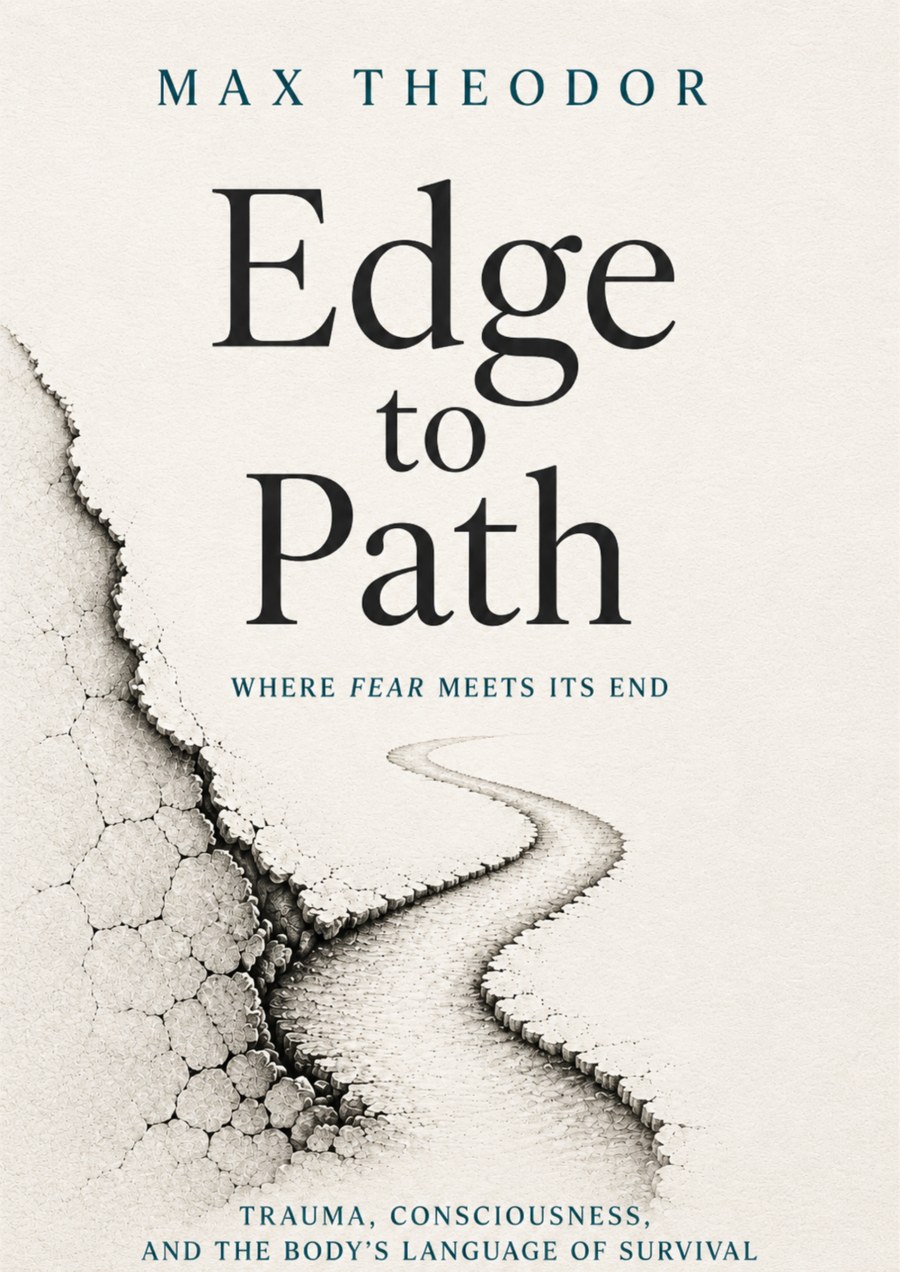
Before fear becomes your next move, there is an Edge. Edge to Path follows that interval: old protection is moving, and awareness has not yet been overtaken.
There is a strange difference between knowing something and having it become true in you.
Helplessness is a report on conditions. Recovery widens what is reachable now without pretending it was reachable then.
The pause between stimulus and response is real. Whether you can reach it depends on what your body is carrying.
New essays are announced on Max Theodor’s Facebook page.