
FEAR & EVERYDAY RESPONSE
Fear: When a response feels necessary.
Fear may arrive as an urgent need to fix something, withdraw, or reply. Edge to Path explores what is expected to happen and why another response can be difficult to reach.
Educational reading, not diagnosis or a guided exercise.

When the terms change
When danger is current or uncertain, protection and outside support come first. Read the safety section. [1, 5]
David’s business partner brings an update: the buyers want to change the terms of a deal. There are payment dates to review and projections to revise. David has handled harder negotiations. He knows the work. [1]
His hands begin to tremble. He keeps his voice level through the conversation. When his partner leaves, David presses his hands flat against the desk. Financial uncertainty has reached an older experience of losing safety, shaped by bills, eviction notices, and instability in his childhood home. [1]
The business problem is real. In “Wrong Frequency,” the book shows it taking on a larger meaning for David: the security he has built could give way. Control starts to feel necessary on a scale the revised terms alone cannot explain. [1]
David is one of the book’s case figures. His story and the later call example illustrate the argument; they are not clinical records or treatment testimonials.
What feels at stake
A tremor is a bodily experience. Losing security is the feared meaning in David’s story. Tightening control is the response that begins to feel necessary. Whether he could reach another response under those conditions is a further question. [1]
These experiences can overlap, arrive in a different order, or remain difficult to separate. A forecast may be felt before it can be described. [1]
Richard Lazarus’s appraisal theory also includes evaluations that occur without deliberate, conscious thought. In that account, what an event means to a person need not begin as a sentence. This is a psychological theory of emotion, rather than a fixed timetable for bodily responses. [2]
Naming a feared consequence can make an experience more specific. It still leaves open whether the expectation fits the present situation, what else may be contributing, and what the person can do. [1]
After the call
A SEPARATE EXAMPLE FROM THE REALITY MAP
“I can’t talk about this tonight.”
From “The Reality Map,” in Edge to Path. [1]

In the book’s call example, the listener hears a real change. Warmth has left the voice. The conversation is ending for the evening. Cold moves along the listener’s forearms, and the meaning expands: the relationship is over. [1]
The wish to prevent that loss takes a particular form. End the relationship first, before the other person can. A reply begins forming around an ending the call has yet to establish. [1]
- What happened
- The other person ended the conversation for tonight.
- What was forecast
- This means the relationship is ending.
- What felt necessary
- End it first. [1]
Questioning that forecast does not promise that the relationship will last. It leaves its future uncertain. The other person’s boundary also remains: the conversation has ended for tonight. Understanding the fear gives no entitlement to an immediate reply or reassurance.
Why the familiar response can feel proven
By the end of David’s working day, the revised model is complete and his partners have been updated. The deal has survived a change. In the chapter’s account, David credits control with keeping him safe. The next round of tighter projections feels justified. [1]
He still has a business to manage. The problem is the expanding demand: evenings and weekends disappear into the effort to prevent another loss of security. The book calls this a correct-response loop, in which an outcome appears to confirm the response that preceded it, while other possibilities remain untested. [1]
An alternative has to be usable
Looking back at the call, it is easy to name another response. Leave the conversation where it ended. Wait before deciding what it means. The harder question is whether either response was within reach at the time.
Edge to Path uses decision space for the choices a person can reach under the conditions of a particular moment. Having words for an alternative is different from being able to consider it, speak it, or carry it out. The book’s examples allow awareness to arrive late, and sometimes to notice a response beginning without being able to change it. [1]
The circumstances extend beyond feeling. A lack of privacy can prevent a call for help. Money, transport, housing, disability access, or responsibility for someone else can change which actions are possible. Understanding a fear does not supply those missing conditions. [1]
Nor does every hesitation need a hidden explanation. Someone may need information, have competing obligations, or simply prefer to decline. A refusal can stand without being interpreted as a symptom.
Perfect calm is not a prerequisite for every useful action. The practical question is what can be reached with the resources and support available. In the book, a return found sooner or words becoming usable can change how an encounter goes. Other changes require practical arrangements outside the person. [1]
The book calls the interval in which awareness can still participate in an unfolding response the Edge. That interval is conditional, rather than a pause everyone can produce on demand. [1]
When the danger is current
A history of fear does not make a present threat less real. Someone’s threatening conduct, coercion, or control needs to be considered on its own terms. A calmer feeling cannot certify that the situation is safe. [1]
When danger is current or cannot be ruled out, assessment and protection take priority over tracing an old pattern. A domestic-violence or survivor-support service can help with safety planning that takes the person’s circumstances into account. If seeking help could be monitored, use the safest available way to reach support. In immediate danger, contact local emergency services. [1, 5]
New, severe, rapidly changing, or otherwise concerning physical symptoms warrant medical assessment rather than an assumed fear explanation. If reading increases distress, stop and seek appropriate support. [1]
What happens after the reaction
Understanding the fear behind a sharp reply can explain something about it. The other person still received the reply.
In Guidance and Resources, accountability can involve stopping harmful conduct, respecting a boundary, changing conditions that keep producing the same encounter, and seeking appropriate help. These actions need not wait for certainty about every cause. [1]
A shorter reaction may reduce the harm it carries. Repair asks more: acknowledgment of what happened and changes that become visible over time. Direct contact belongs where it is safe and wanted. The person who was hurt may decline an apology or want distance, and understanding the fear does not remove that choice. [1]
Fear is part of the explanation. What happened, what it cost someone else, and what changes afterward remain separate questions.
Questions about fear
Does fear always come from trauma?
No. This page uses examples from a book about trauma and survival patterns; it does not assign a traumatic origin to every fear. Current risks, ordinary uncertainty, preferences, and practical constraints remain relevant. Recognizing part of an example does not establish a diagnosis or a hidden history. [1]
What if I cannot identify a fear or a bodily signal?
There is no need to supply an explanation to complete the pattern. The book allows unclear sensation, mixed information, and “I don’t know.” Looking at the circumstances or seeking appropriate support can be more useful than trying harder to find something inside. New or concerning physical symptoms still need medical attention. [1]
Is the goal to stop feeling fear?
The book’s practical concern is how much authority a familiar response has over what happens next. Fear or a reminder may remain while a person gains more access to a different response. That is an account of change, not a promise that reading will produce a particular outcome. [1]
Where does MBT fit into this account?
Tom Campbell’s My Big TOE, or MBT, supplies the book’s consciousness framework, including its language of fear, belief, intent, and decision space. The book distinguishes that framework from clinical models and scientific findings. These examples can be examined without accepting consciousness as primary; the studies here do not establish that ontology. [1]
Read Edge to Path
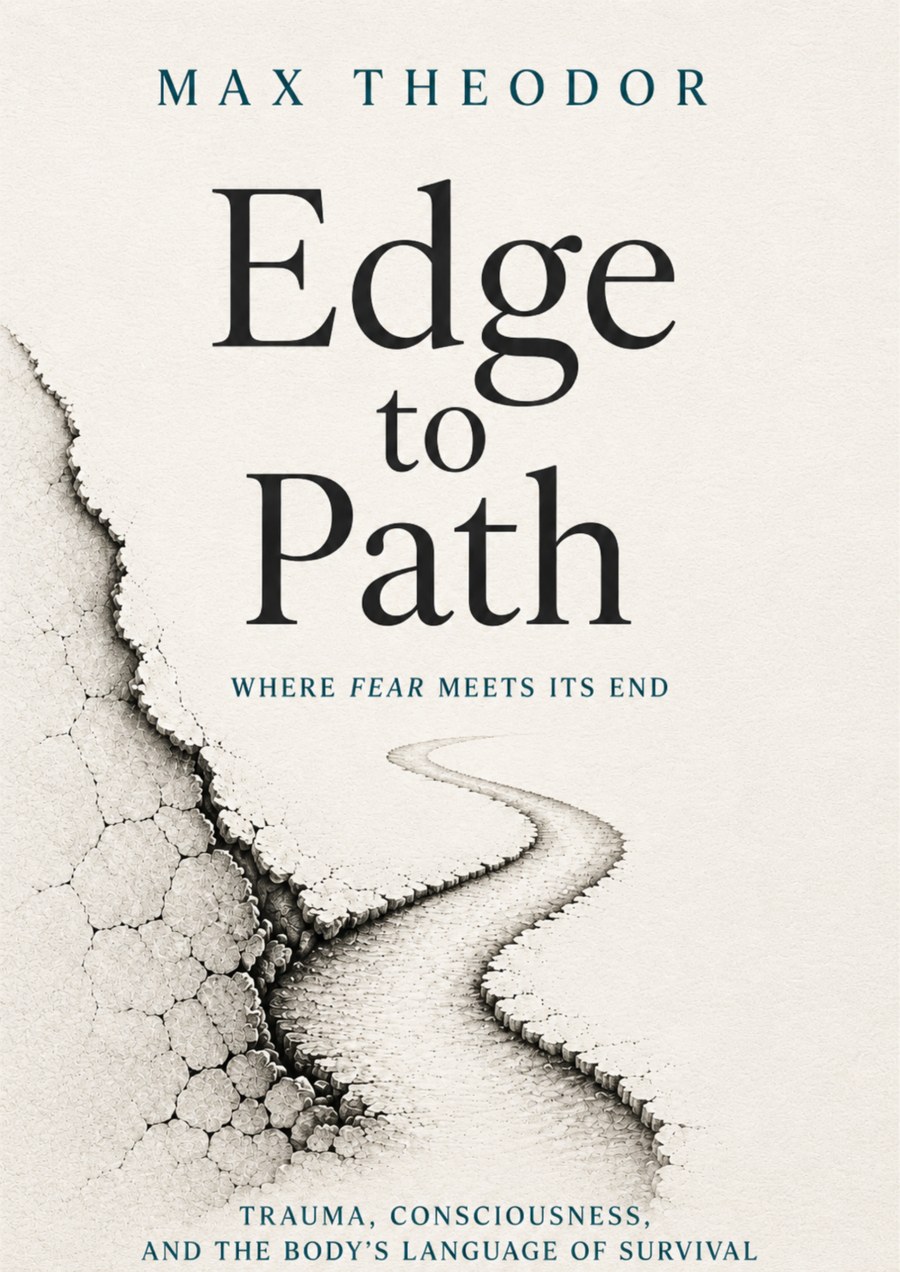
The examples here are brief. In Edge to Path, fear is followed across working days, relationships, bodily experience, and the consequences of a response. First-person testimony and recurring case narratives give the questions a life beyond their definitions. [1]
The book brings neuroscience, somatic practice, and Tom Campbell’s MBT into the same inquiry while keeping their claims distinct. Read the free opening chapter to meet the writing, or continue with the full book. The free Field Guide offers questions for reflection alongside it. [1]
Ebook · US$12.99
Sources and distinctions
David’s story and the call example are drawn from the book’s illustrative material, rather than clinical records. The named theory, laboratory experiments, safety guidance, and author synthesis have different roles. None of these studies tested Edge to Path as a treatment.
Max Theodor. Edge to Path. 2026. Relevant sections: “Wrong Frequency,” “The Reality Map,” “The Ratio,” Guidance and Resources, Notes and Sources, and Glossary. These supply the examples and the book’s distinctions among bodily experience, forecast, command, and reachable response. Explore the book.
Richard S. Lazarus. “Cognition and motivation in emotion.” American Psychologist. 1991;46(4):352–367. A theoretical account that includes automatic and unconscious appraisal. Read the article record.
Peter F. Lovibond and colleagues. “Safety behaviours preserve threat beliefs: Protection from extinction of human fear conditioning by an avoidance response.” Behaviour Research and Therapy. 2009;47(8):716–720. A laboratory experiment, rather than a test of the book’s examples. Read the study record.
Sophie L. van Uijen and colleagues. “Do safety behaviors preserve threat expectancy?” Journal of Experimental Psychopathology. 2018;9(4). Two experiments examining different forms of safety behavior. Read the article.
National Domestic Violence Hotline. “Create Your Personal Safety Plan.” Guidance on personalized safety planning during abuse, when preparing to leave, and afterward. Consulted September 17, 2026. Read the guidance.